
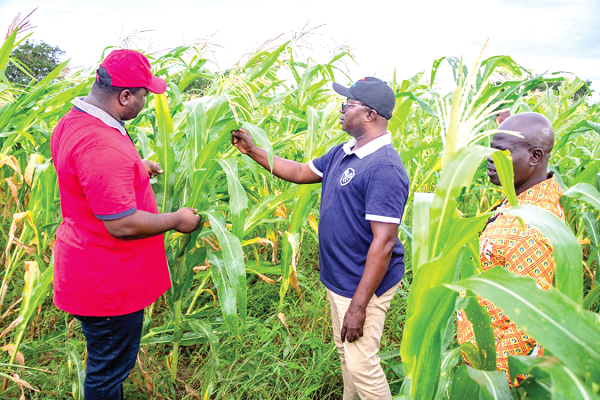
The press secretary of the Minister of Agriculture, Alhassan Ridwan says the Ministry has considered adding maize to the Planting for Food and Jobs (PFJ) market.
Chocolate market faces turbulence as Ivory Coast and Ghana throw down gauntlet on cocoa price.
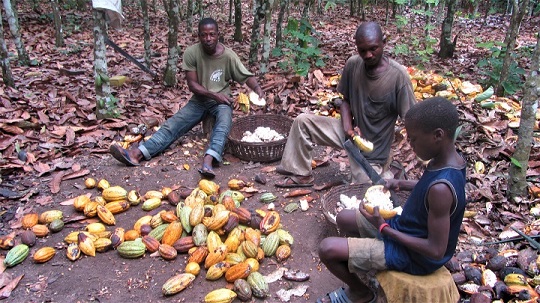
The world’s chocolate industry could be in for a turbulent ride as the two biggest cocoa producers set down demands for manufacturers to pay higher prices for their growers.
The quarrel focuses on the Living Income Differential (LID) – a policy that Ivory Coast and Ghana introduced in 2019 to fight poverty among cocoa farmers in the global US$130-billion chocolate market.
Under it, Ivory Coast and Ghana vowed to charge a premium of US$400 per tonne on all cocoa sales, starting with the 2020/21 harvest.
But trade boards in the countries – the Ivorian Coffee-Cocoa Council (CCC) and the Ghana Cocoa Board (Cocobod) – say the scheme is being undermined as cocoa traders depress the price of another premium that operates in parallel.
“We’ve introduced the Living Income Differential as a means of improving the farmer income,” said Fiifi Boafo, Cocobod’s spokesperson.
“You have these companies circumventing these processes to ensure that the Living Income Differential effect is not felt in (their) lives.”
The two countries together account for 60 per cent of the world’s cocoa but their farmers earn less than six per cent of the industry’s global revenue.
They are threatening to punish corporations by barring them from visiting plantations to estimate harvests – a key factor in cocoa price forecasting.
They are also threatening to suspend sustainability programmes that chocolate giants use to enhance their image with fast-growing ethnic consumers.
“This boycott and also ultimatum is to draw attention to the fact that inasmuch as it is important for us to talk about deforestation, it is important to talk about child labour, it is equally important to talk about the farmer income,” said Boafo.
The LID premium is being completed by a price stabilisation fund to help buffer the international price of cocoa in the event of big market fluctuations.
Some experts say the chocolate giants have factored the LID into their costs but claw back some of this by exerting pressure on another premium based on the quality of cocoa beans.
This premium, known as the origin differential, has plunged below zero in recent years, effectively cancelling out part of the LID. Covid-19 is being used as “a pretext not to pay,” CCC President Yves Brahima Kone told Agence France-Presse.
“The thing is, the multinationals have increased their profits – they are able to pay.”
The World Cocoa Foundation, an umbrella group of public entities and corporations aimed at supporting sustainability in the sector, declined to comment on the face-off.
Among corporations, Nestle said it strongly backed efforts for growers to maintain a decent standard of living and had been paying the LID since its inception.
Some experts say that time may weigh against Ivory Coast and Ghana if the row escalates. Virtually all of Ivory Coast’s crop is bought by roughly half a dozen majors.
Of this, around 80 per cent heads to Europe, the wealthy market where sustainability factors – environmental and labour criteria – count most for consumers.
“Ivory Coast’s economy is heavily dependent on cocoa income,” said one specialist. “It needs to sell its beans.”
“Stopping sustainability programmes is difficult to explain to the general public, and Ivory Coast’s image could (also) suffer.”
Nestlé’s partnership is to boost agriculture production for food sustainability to reduce hunger – Patricia Ekaba.
Nestlé is partnering with the Centre for No-Till Agriculture (CNTA) at Nkawie-Toase, in the Ashanti Region, to implement regenerative agricultural practices for maize in Ghana.
Take advantage of the world economic crisis to upscale production and maximize profit – horticulture exporters urged.
Horticulture exporters have been challenged to take advantage of the looming shortage of fruits and vegetables in Europe as a result of the raging Russia-Ukraine war to maximize their gains.
Food prices to edge down in 2023 as recession looms – Rabobank.

Prices for agricultural commodities like coffee, feed grains, and oilseeds could dip next year as many major economies enter recession, but they will remain high in historic terms, Rabobank said in a report on Wednesday.
Good pricing is the engine to sustaining the cocoa sector – Farmer Pomasi.
As part of the efforts to help address challenges hampering the production of cocoa in the country; SEND Ghana in partnership with INKOTA Netzwerk and SUDWIND has taken another judicious step by meeting key stakeholders within the cocoa value chain to discuss issues bothering living income and human rights in Ghana’s cocoa sector.
Jospong Group to support and develop the rice sector to cease rice importation.
Rice is the second most consumed food commodity in Ghana cuisine. Ghana imports rice worth millions of dollars every year derailing economic growth. Ghana’s rice production is about 960,000mt as against 1.4mmt consumption making it dependent on foreign countries for the rest of the quantity consumed.
Transportation cost is not responsible for price hikes of food commodities – Agric Minister
The Minister for Food and Agriculture, Dr. Owusu Afriyie Akoto, says the high cost of transportation is not to blame for soaring food prices.
The latest figures show inflation for October is more than 40% driven largely by food and transportation prices.
Food inflation recorded the highest rate among all the components as against non-food inflation according to the Ghana Statistical Service.
Many have suggested that the astronomical rise in the prices of petroleum products is taking a toll on transportation rates, which is then borne by the consumer.
But answering questions in Parliament, the Minister said the analysis of the Ministry does not point to transportation costs as the cause of the hikes.
He however fell short of explaining exactly what is causing the increase.
The Minister also defended his outfit’s plans to bring food from the local areas to Accra in order to compete with the high cost of food on the market.
The increase in food inflation indicates a jump of more than 3 percent from the previous rate of 37.2%.
Addressing the media, Government Statistician, Prof Samuel Kobina Annim explained that all items in the component for calculating the rate of inflation recorded an increase.
“For the month of October, Food inflation was 43.7%. Last month’s Food inflation was 37.8%. A careful study of the figures show that month-on-month Food inflation was 3.2%.” he said.
Government to support farmers with $150m Indian Exim Bank facility.
The Minister of Food and Agriculture, Dr. Owusu Afriyie Akoto says the Ministry of Food and Agriculture (MoFA) is arranging a US$150 million from Indian Exim Bank facility to support farmers in the Southern, Middle and Northern belts of the country.
According to him, a detailed project report for implementation has been prepared by a consultant.
The sector minister revealed this on the floor of Parliament in Accra in response to a question from Member of Parliament for Awutu-Senya West, Mrs Gizella Tetteh-Agbotui on efforts the Ministry is instituting to establish mechanisation centres for farmers in the Awutu-Senya District.
Dr. Afriyie Akoto cited that since 2018, the MoFA has imported various agricultural machinery and equipment from Brazil for sale to interested farmers, institutions and new investors at subsided rates across the country.
“Mr. Speaker, this is intended to promote the establishment of private sector-owned mechanisation centres to support farmers,” the Minister said.
Dr. Afriyie Akoto stated that mechanisation centres are to bring smallholder farmers together as a group to have the services of mechanisation at subsidised rates.
Ghana’s food security status strengthened- Agric Minister.
The Minister of Food and Agriculture, Dr. Owusu Afriyie Akoto has noted that, interventions by the current government in the last five years have laid a solid foundation for sustainable food availability, accessibility, utilization and stability even in times of major adversity, food production has been consistent, ensuring the needed stability and resilience that every country needs to survive.
He said, this has been made possible through the sound and pragmatic policy of the government and everyone should support the ongoing effort to build a strong food sector that ensures self-reliance, value addition and the needed linkage to industries.
According to Dr. Owusu Afriyie Akoto “Government’s investment toward National Food Security within the space of 5 years from 2017, I dare say is unparalleled in the history of this country”.
Responding to an urgent question from, MP for Gomoa east, De-Graft Piatoo on measures the Ministry intends to adopt or have adopted to improve on food security in the country, the Minister said, FAO has established four 4 pillars of food security namely: Availability, Accessibility, Utilization and Stability and “using these pillars as a basis for assessing the status of Ghana’s food security, there is no question that Ghana is more than food secure”.
On food availability, the Minister said, “since the rollout of the government flagship programme Planting for Food and Jobs (PFJ) in April 2017, data and physical evidence amply attest to a consistent and enhanced food security status of the country. At the very outset, the PFJ campaign signaled the very high premium placed on food security by the government. This explains why the food crop module of the PFJ was the first to be out-doored”.
In terms of food utilization, he said, “Ghana annually experiences a lot of waste and surpluses, to address these problems the government is constructing 80 warehouses across the country.
Most of these warehouses are currently being put to use at District Assemblies after completion to ensure that these warehouses are put to optimal use to serve their purpose.
The Ministry is inviting private sector participation in the management of that facility and advert to that effect has been put in the newspaper, expression of that effect from the private sector”.