
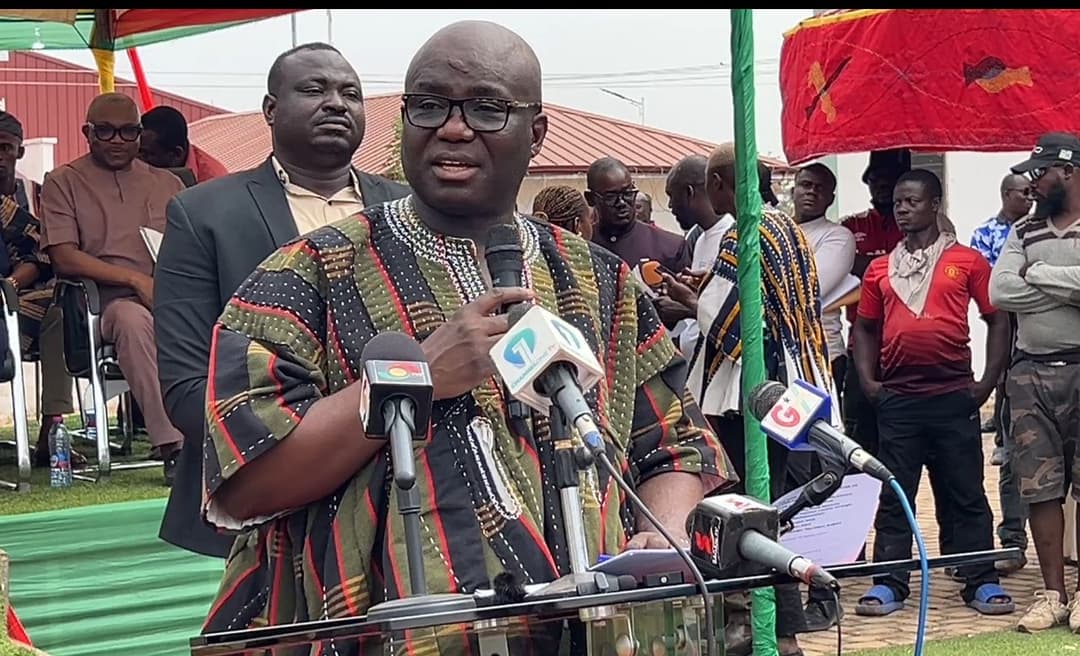
The Minister for Food and Agriculture Eric Opoku has reaffirmed government’s commitment to building a resilient and efficient agricultural sector, as Ghana shifts focus from only increasing production to protecting what farmers harvest.
Speaking at the launch and handover of locally fabricated post-harvest equipment, the Minister said the event represents the kind of agricultural future Ghana has deliberately chosen to build one anchored in local innovation, value addition, and sustainability.
He noted that for far too long, Ghana has invested heavily in boosting agricultural production yet continues to lose a significant proportion of what farmers harvest due to poor post-harvest handling.

According to him, inadequate storage and processing services have robbed farmers of income, wasted effort, and weakened the country’s food systems.
As part of the programme, 2,231 youth artisans have been engaged to fabricate about 300 maize and soybean threshers. The Minister emphasized that the project is not only about numbers, but about building a skilled workforce that will continue to serve the agricultural sector long after the programme ends.
More than 3,000 farming families are expected to benefit from the initiative. The impact, he said, will be felt through reduced post-harvest losses, higher incomes, improved quality of produce, and stronger rural economies.
The Minister highlighted sustainability as a key feature of the programme, stressing that equipment without skills and technology without maintenance often fail. To address this, the initiative includes user training, technical support systems, and the involvement of trained agricultural and engineering graduates to ensure safety, reliability, and continuity.

He stated that the future of Ghana’s agriculture lies in efficiency, value addition, and dignity of work. It also depends on empowering women farmers, equipping young people with relevant skills, and ensuring that what the country grows is not lost, but leveraged for national development.
On the part of the Country Director of World Food Programme, she described the initiative as a practical Ghanaian solution to one of the most persistent challenges in agriculture post-harvest losses. He said WFP approaches food security holistically, from production and harvesting to processing, storage, and access to markets.
According to her, significant quantities of maize and soybeans are lost after harvest in Ghana, undermining farmers’ incomes, nutrition outcomes, and national food availability, while contributing to rising food prices.
It is being rolled out across seven technology solution centres, with 231 young Ghanaian artisans trained to fabricate 300 threshers—200 for maize and 100 for soybeans.
Beyond equipment delivery, the programme includes user training, maintenance services, and the deployment of agricultural engineering graduates to ensure safe operations and long-term sustainability. WFP says the initiative aligns with Ghana’s Feed Ghana programme and the country’s mechanisation agenda.