
UG Nkabom Collaborative, a strategic initiative aimed at transforming Ghana’s agrifood system by empowering youth to take opportunities in the food and nutrition value chain has called for effective partnership to thrive Ghana’s agrifood system.
This call was made when UG Nkabom Collaborative as part of its broader effort to create awareness, and enhance visibility converged the media professionals to share its knowledge to improving Ghana’s agrifood systems.
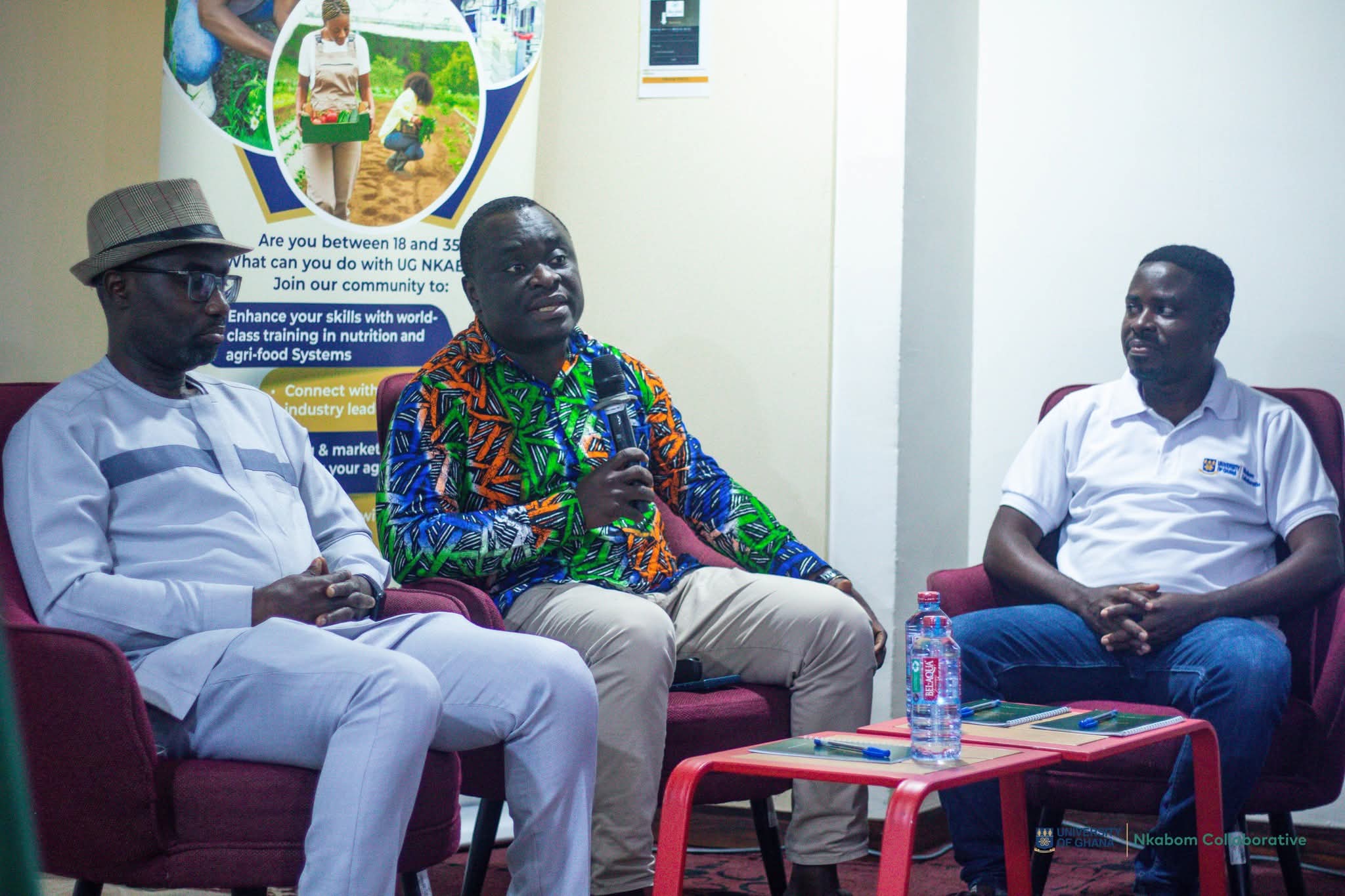
“We are not only thinking about classroom knowledge, but we are also thinking especially about hands on practical knowledge”, Prof. Richard Aryetey, UG Nkabom team Lead said when explaining the vision, mission and what make UG NKabom different from other programmes.

According to Prof, one of the key interventions of UG Nkabom Collaborative is to bring young people together, build their capacity to be able to produce enough and the kind of food that addresses health issues in the system and to address ecosystem problems.
To achieve this, Education, Entrepreneurship and Access and Success are the three main pillars that UG Nkabom Collaborative operate with to change the mind set of the young individuals to improve agrifood systems.
In terms of education, he explained, the beneficiaries, especially those who are already working in agrifood system are trained in short courses that are practical to improve upon their existing ventures. New PhD programmes in sustainable food systems are developed for the frontiers in the agrifood systems to integrate to their already existing knowledge to understand the mixtures of culture to address the agrifood issues holistically.
Entrepreneurship, he said, one of the keyways to alleviate unemployment among the skilled individuals is to create pathways that enable skilled individuals to create their own jobs.
So far, 100 young individuals with rich ideas have been given seed funding to improve on the ideas to prototype level to develop them further.
Women constitute greater percentage working force of the agrifood systems. Women are the main players in the agrifood systems; thus, from production till the food get to the table of the consumer, therefore, the programme prioritises women inclusion.
He added that the programme prioritises persons with disabilities and those who are displaced either politically or any other reason.
“Our unique selling preposition is the systems we are developing and putting in place to make sure we succeed. Our founder is not interested in how many people we have trained or seminars we have organised, our founder is interested in how many descent jobs we have created, how many enterprises we have established. So, from the word go, we are mindful of sustainability.”
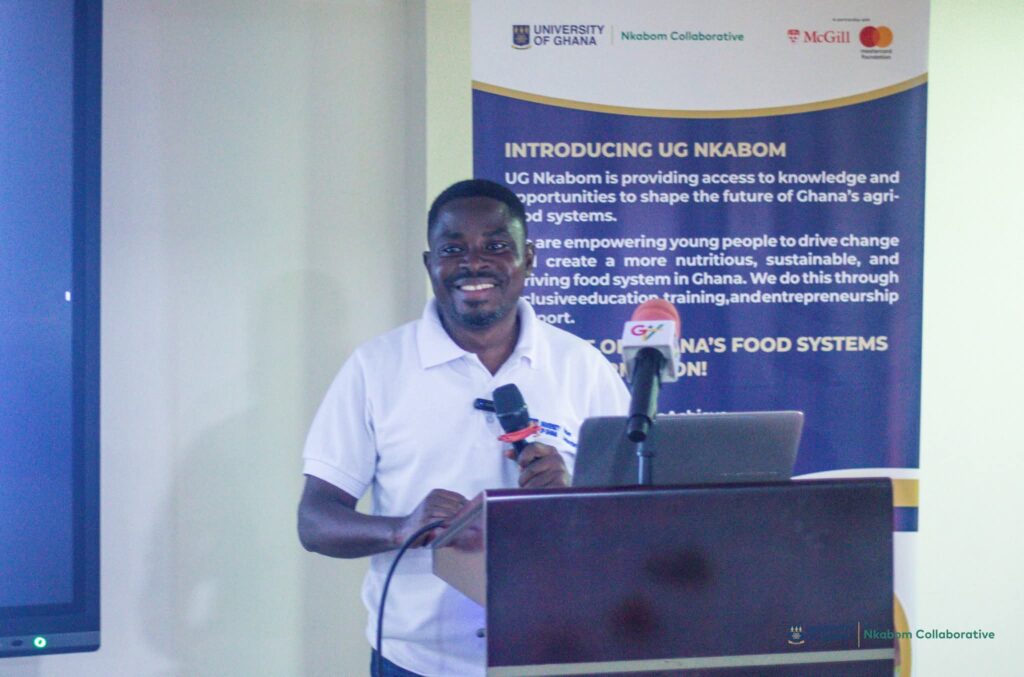
Dr. Hayford Mensah Ayerakwa, UG Nkabom Collaborative Education Lead explains the uniqueness of UG Nkabom Collaborative’s programme to other programmes that geared towards achieving food security.
To this, he highlighted, the UG Nkabom Collaborative programme is to train twenty-one thousand young (21000) individuals on the short course and twenty-five (25) at PhD level for the 10 years of the programme’s duration.
Moreover, entrepreneurship is to create fifty-five thousand (55000) jobs and three thousand (3000) enterprises at the end of the 10-year duration.
So far, Dr. said the education has train one hundred and forty-four (144) young individuals on short courses, and hundred (100) young individuals which out of ninety-two (92) have received seed funding of Ninety-two thousand dollars ($92,000).
He called on the general public and the agrifood system enthusiast to partner with UG Nkabom Collaborative thrive Ghana’s agrifood system.
About UG Nkabom Collaborative.
The UG Nkabom Collaborative is a decade-long project led by the University of Ghana to transform Ghana’s agri-food sector by empowering youth.
It is a collaborative effort with key partners like McGill University and the Mastercard Foundation and other institutions, focusing on three pillars: education, entrepreneurship, and access and success.
The project aims to address youth unemployment by creating new academic programs, supporting young entrepreneurs, and offering training and scholarships to underserved youth, with a goal of creating a more inclusive and sustainable agri-food system.Key goals and pillars.
Education: Develop a new generation of professionals for the agri-food sector through academic programs and short courses.
Entrepreneurship: Support young people in starting and scaling their own businesses within the agri-food system through mentorship, incubation, and funding opportunities.
Access & Success: Provide educational scholarships and grants to underserved youth, including internally displaced persons, girls, and people with disabilities, to ensure inclusive participation.