
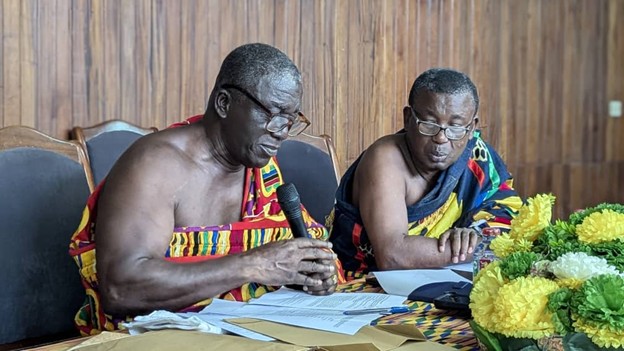
The Western Regional House of Chiefs (WRHC) has called on government to impose a total ban on the export of raw rubber.
The house warned that proposals to merely restrict exports will continue to undermine domestic processing and derail Ghana’s industrialisation drive.
Nana Kobina Nketsia V, the President of the WRHC, pointed out that the continued export of raw rubber, particularly from the Western Region which is Ghana’s leading rubber-producing enclave, runs counter to government’s own policy direction on value addition, job creation and local content development.
At a general meeting of the house at Sekondi, Nana Kobina Nketsia said chiefs in the region were unanimous in their demand for a complete prohibition, not a partial limitation, on the export of natural rubber in its raw form.
“It was clearly stated in the 2026 Budget that the discussion was about natural rubber. However, the way the minister framed it suggested a restriction on the export of raw rubber. We are not asking for a restriction; we are asking for a total ban,” he stated.

According to him, a full ban would guarantee steady supply of raw materials for local processors, revive struggling rubber-based industries and align fully with flagship government initiatives such the 24-hour economy policy.
Nana Nketsia, who is also the Paramount Chief of the Essikado Traditional Area, noted that local processors, including Ghana Rubber Estates Limited (GREL) in the Western Region, have been starved of raw materials due to excessive exportation, forcing the company to cut its workforce by half and reduce operations from three shifts to one.
Similarly, a rubber-processing company in the Central Region has shut down entirely due to lack of raw material, according to the Association of Natural Rubber Actors of Ghana (ANRAG).
Although he said Parliamentary Select Committee on Trade and Industry recently expressed support for government’s decision to restrict raw rubber exports beginning in 2026 and pledged to assist in drafting the necessary Legislative Instrument (LI), the traditional ruler insisted that restriction alone will not address the fundamental problem.
“Exporting raw rubber directly contradicts the government’s stated policy direction and undermines the domestic industry. If we are serious about industrialisation, then we must process our rubber here instead of exporting it in its raw state.”
He further called for stricter enforcement of existing laws governing raw material exports, arguing that Ghana’s challenge lies more in weak implementation than lack of policy.
“There are laws against exporting materials in their raw form. We must support government and work with them to ensure the regulatory framework functions effectively. This is not just for producing areas, but for the benefit of the entire country,” he added.
Drawing parallels with the mining sector, Nana Kobina Nketsia lamented on a long-standing pattern of extracting resources from host regions without corresponding local processing or industrial development.
He cited public concerns over plans to site a national gold refinery in Accra instead of mining regions in the Western Region, saying such decisions are economically and socially unjustifiable.
“If the gold is mined here, why should the refinery be in Accra? If the aim is to create jobs and curb illegal mining, then these facilities must be located in the producing regions,” he said.
The Paramount Chief of the Gwira Traditional Area, Awulae Angamatuo Gyan, supported the call, revealing that traditional authorities in the region have engaged the Ministry of Trade and Industry and the 24-Hour Economy Secretariat on the issue.
“We have raised concerns about raw rubber exports for many years through engagements with relevant institutions. Although the results have been slow, we are hopeful that government’s current position on restriction will be a stepping stone toward a full ban,” he noted.
Also contributing, Awulae Attibrukusu, Paramount Chief of Axim Traditional Area, welcomed government’s intention to restrict exports but stressed the need for a united regional stance to push for a complete ban.
“As a region, we must come together and meet the relevant authorities to clearly state our resolve to have a total ban on raw rubber exports,” he said.
He proposed a joint petition by traditional leaders, opinion leaders and other stakeholders in the Western Region to formally communicate their position to government and Parliament.
The Western Region remains Ghana’s largest producer of natural rubber, with thousands of smallholder farmers and several large plantations depending on the sector for their livelihoods. Chiefs argue that banning raw rubber exports will stimulate local processing, create thousands of direct and indirect jobs, boost government revenue and promote sustainable industrial growth.