
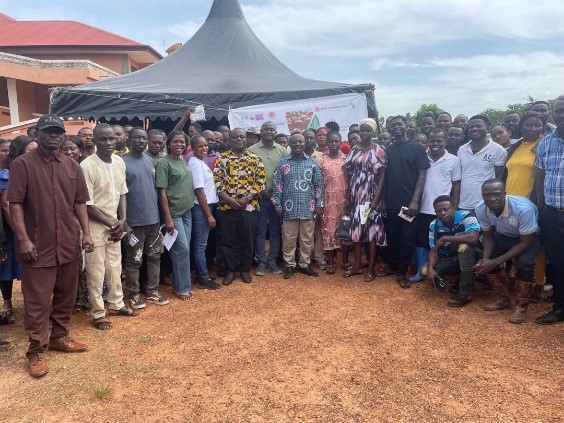
About 150 smallholder vegetable farmers in the Bono Region have received intensive training in improved agronomic practices and vegetable nutrition aimed at increasing the production of tomato, okra and amaranth, while strengthening Ghana’s vegetable value chain.
The farmers, selected from the Berekum West District, Berekum Municipality and Dormaa Municipality, were trained in seed selection, planting seasons, land preparation, nursery management, and the safe and efficient use of agrochemicals, including fertilisers and fungicides.
The capacity-building programme forms part of efforts to improve the livelihoods of smallholder farmers through the adoption of improved vegetable varieties, higher productivity and sustainable production practices.
The training was organised under the Technologies for African Agricultural Transformation (TAAT) initiative, launched by the African Development Bank (AfDB) in 2018 to accelerate agricultural growth, enhance food security and promote inclusive economic development across Africa.
In Ghana, the Council for Scientific and Industrial Research–Crops Research Institute (CSIR-CRI) is implementing the TAAT II Vegetable Compact Project, which is promoting improved technologies and modern production practices to make the country’s vegetable sector more competitive and sustainable.
Addressing a durbar of farmers at Jinijini in the Berekum West District, the Principal Research Scientist and Vegetable Breeder at CSIR-CRI, Dr Michael Kwabena Osei, said low productivity remained one of the biggest challenges facing Ghana’s vegetable industry.
He noted that tomato farmers using local seed varieties currently harvest between 7.5 and 10 tonnes per hectare, whereas improved varieties can produce up to 20 tonnes per hectare when combined with good agronomic practices.
According to him, the persistent yield gap is largely driven by the use of inappropriate seed varieties and poor farming practices, with limited technical knowledge continuing to undermine efforts to increase vegetable production.
“Lack of relevant knowledge makes farming unattractive and unproductive,” Dr Osei said.
He also expressed concern about the excessive and often inappropriate use of agrochemicals, stressing the need for continuous farmer education on the correct application of fertilisers, fungicides and other crop protection products.
“We need to keep educating farmers on the appropriate use of these chemicals, including when and how to apply them, as well as the recommended waiting period before harvesting produce after chemical application,” he said.
A Research Associate with the World Vegetable Center, Dr Alhassan Zaato, highlighted the nutritional importance of vegetables, describing them as rich sources of essential vitamins and minerals that boost energy levels, strengthen immunity and promote overall well-being.
He urged intensified public education to encourage regular vegetable consumption as part of a balanced diet while supporting increased demand for locally produced vegetables.
Speaking on behalf of the participants, 50-year-old farmer Dominic Oti Yeboah appealed to the Ministry of Food and Agriculture to improve farmers’ access to high-yielding and disease-resistant tomato varieties, particularly the ‘Kwabena Kwabena’ variety.
He said making improved seeds readily available would significantly increase tomato production, raise farm incomes, improve livelihoods and contribute to Ghana’s food security.
The TAAT II Vegetable Compact Project is expected to accelerate the adoption of improved production technologies among smallholder farmers, helping to close the country’s vegetable yield gap, improve the supply of quality vegetables to the market and enhance the resilience and profitability of Ghana’s agribusiness sector.