

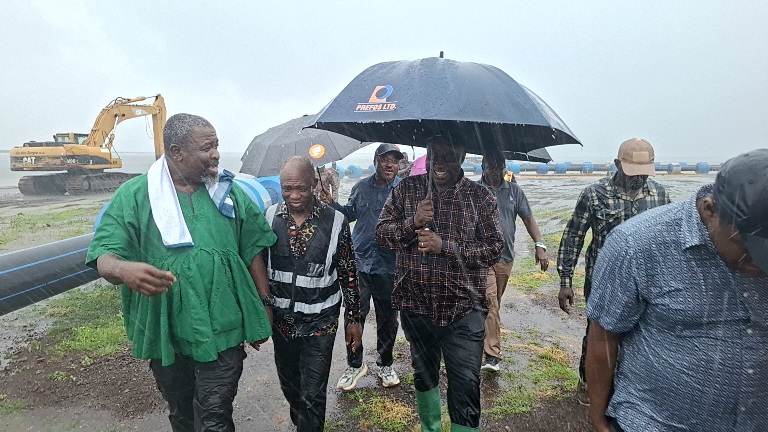
Currently, Ghana’s import bill is around $3billion annually. To mitigate importation, create more employment, and improve the living standard of the farmers, the government, through the hardworking agric Minister with the auspices of Feed Ghana Project, is constructing the biggest irrigation project in West Africa at Afram Plains to ensure year-round production of food crops.
The hardworking Minister of Food and Agriculture, Hon. Eric Opoku, has paid a working visit to inspect the ongoing irrigation projects at Afram Plains to assess the 96% and 85% completion of the projects to ensure national food security.
A Visit to Kwahu Chiefs
During the visit, the Minister paid homage to both the Kwahu Nkwatia and Kwahu Abetifi chiefs to seek permission to enter the land and their prayers and support to make the journey and the project a success.
The Chiefs warmly welcomed the Minister and gladly said the lands are available for production, but without sowing, there cannot be a harvest.
“We have the lands available, where the irrigation project has been built, all for us. We are happy this project is taking effect; it will bring employment to the youth at the Afram Plains”, the Chiefs added.
They commended the government and the agric minister for the project that seeks to irrigate the farms all year-round to ensure food security in the country.
They assure the minister of their support and commitment to the project for the benefit of Ghanaian youth.
Ekyeamamfrom Economic Enclave Irrigation Project
The Minister continued his visit to Ekyeamamfrom Economic Enclave Irrigation Project. The project was 85% complete for use.
According to the consultant, the project could irrigate eight hundred (850) and fifty acres of land that could serve thousands of farmers at the enclave. Hon. Minister was fascinated by the amount of water that the scheme could provide to the farmers.
Irrespective of the size of the project, the Minister is willing to add more land for more pivots and pumps to be constructed.
Questioning the total completion of the scheme to be used by the farmers, the consultant assured that the earliest the project can be completed is August, and the worst time is early September this year.
Challenges at the Ekyeamamfrom Economic Enclave Irrigation Project
The consultant raised two critical issues regarding the completion of the project. He mentioned that certificates for payment have been raised, but the government has been able to pay only 40%; therefore, they are short of funds.
Again, the issue of Fulani herdsmen is very disturbing to the project. According to the consultant, the government needs to evacuate the Fulani with their cattle from the enclave. He explained that the Abetifi Traditional Council has had discussions with the Fulani herdsmen and has located them a place for resettlement; therefore, it’s left to the government to evacuate the herdsmen to the location.
Response by the Minister
In response to these challenges, the Minister assured him that he would follow up with the Ministry of Finance to ensure prompt payment to complete the project on time for the farmers to ensure production all year round.
He called the District Chief Executive to arrange for the evacuation of the Fulani from the project location to the place allocated.
Konadu Economic Enclave Irrigation Project
Proceeding to the Konadu Irrigation Project, the project is 96% completed according to the consultant. He said the project would be completed and handed over to be used in November this year. The Konadu Irrigation Project is the biggest irrigation facility in West Africa.
Challenges at the Irrigation Site
The consultant said the completion time is near, but the officers to be trained to use the facility are not at their disposal.
He mentioned that there particular building that is blocking seven pivots from irrigating the farms and that needs to be demolished. Again, he underscored the challenges that the project is facing at the hands of the Fulani herdsmen.
Lastly, illegal timber loggers are causing destruction to the roads that have been constructed in the irrigation site. The timber loggers plough the road to illegally transport the timber logs to their destination.
Minister’s Response to the Challenges
Minister called the DCE to immediately assist in demolishing the building that has blocked the pivots from irrigating 360 degrees.
Moreover, he urged the DCE to facilitate the evacuation of the Fulani herdsmen from the project site to the allocated land.
To the illegal loggers, the Minister said the DCE should coordinate with the police to arrest the drivers who use the farm roads as their route. He urged the DEC to construct a checkpoint at the entrance and the exit of the farm road to monitor the accessibility of the various vehicles that use the road.
Minister’s observations and remarks on the visit to the Irrigation project.
“Generally, we are impressed with what we have seen so far, except that the work is not completed. We all hope that by November, the entire facility will be ready,” the minister commended.
He urged them to make arrangements with the officers for the consultant to train in order to facilitate the use of the facility.
He noted that the government and the ministry are not interested in the materials in the field, but rather the services that can be rendered to the people of Ghana after committing their resources to the government.
He urged them to work assiduously to complete the operationalization for the Ghanaian farmers and to safeguard food security in the country.
He commended the Abetifi Traditional Council for its commitment to the project. He urged the council to assist with the security issues in the enclave, especially with the Fulani herdsmen, the encroaching buildings, and the timber logging.