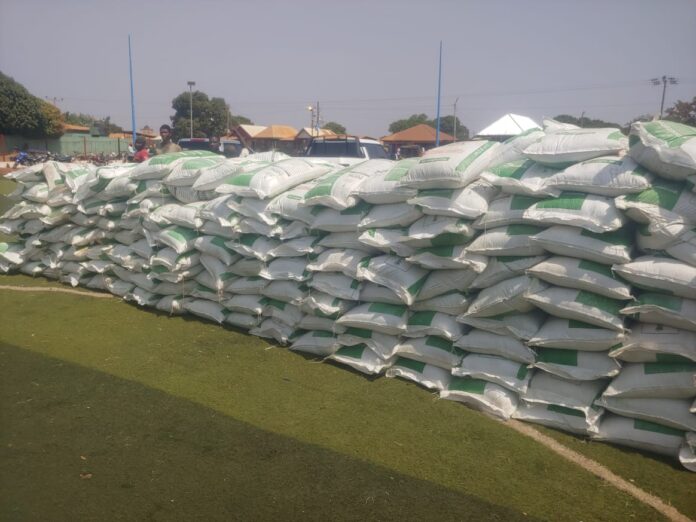
The Chief Executive Officer of the National Entrepreneurship and Innovation Programme (NEIP), Eric Adjei, is today, Monday, August 31, 2026, distributing free fertiliser to farmers across the Jaman North Constituency to support agricultural production and ease the financial burden on rural households.
The initiative aims to support local farmers in improving their yields and strengthening food production in the constituency. Mr Adjei said the intervention was his personal expression of appreciation for farmers whose work sustains families and communities throughout the year.
He said supporting farmers was essential to strengthening the local economy and improving the livelihoods of rural households, stressing that when the people who produce food are supported, the entire community benefits.
Our local farmers are the true heart of our community. They are the very people who have fed me, nourished our families, and sustained us through every season with their tireless dedication. To express my deepest gratitude for their hard work, I am personally distributing free fertilizers to our dedicated farmers across the Jaman North constituency to support their harvest and lighten the load on rural households.
When we lift up the hands that feed us, our entire community grows stronger. By standing beside our farmers and supporting their labor, I hope to bring a rich, bountiful season to every home and a prosperous future for us all.
In a Facebook post on Sunday, August 30, Mr Adjei described local farmers as the “true heart” of the community and said he was distributing the fertiliser to help them achieve a productive farming season.
“When we lift up the hands that feed us, our entire community grows stronger,” he said, adding that he hoped the support would contribute to a rich and bountiful harvest and a more prosperous future for households across Jaman North.
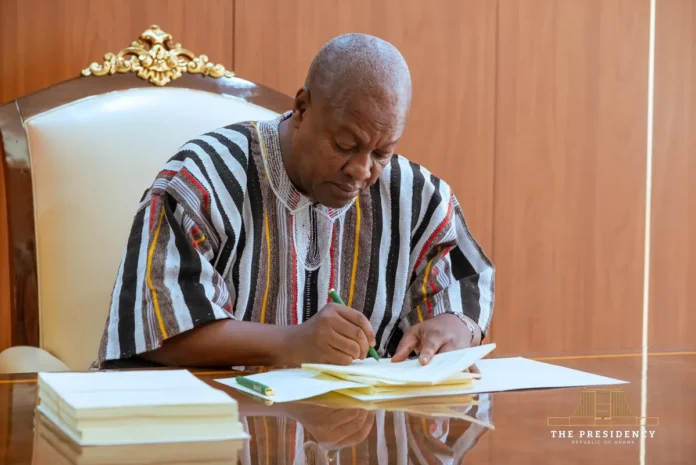
President John Dramani Mahama has expressed the view that cocoa farmers will be happy with the Ghana Cocoa Board Bill that he recently signed into an Act.
He said that the promise he made to farmers that they would earn 70% of the world market price of cocoa is also contained in this Act; therefore, it is a promise made and a promise fulfilled.
President Mahama said this after signing ten major legislative bills into law, marking a step toward structural reforms to accelerate economic growth, plug revenue leakages, modernise justice delivery, strengthen national security, and relieve Ghanaian workers and farmers.
The new enactments cut across critical sectors of the economy, business, law enforcement, maritime security, education, and social protection.
After signing the bills into law, President Mahama, joined by his Chief of Staff, Julius Debrah, PhD, and ministers of state, said the legislative push fulfils key government pledges and lays a streamlined legal foundation for sustainable national development.
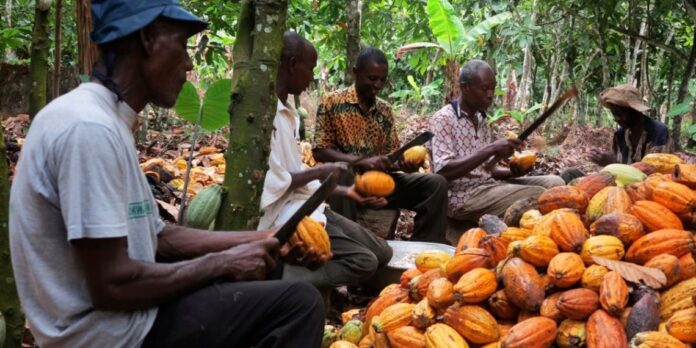
Among the enactments is the Ghana Cocoa Board Act, 2026, which binds the government to its promises to transform the country’s agricultural landscape and guarantee fair returns for cocoa farmers.
“I’m sure our cocoa farmers will be happy,” President Mahama stated. “It incorporates the reform of the cocoa sector and includes our promise that we’re going to process at least 50% of our cocoa beans locally. Aside from that, the promise we made to farmers that they will earn 70% of the world market price of cocoa is also contained in this bill. So, promise made, promise fulfilled.”
To protect low-income households, the President assented to the Income Tax Amendment Act, 2026, which removes tax burdens from low-wage workers.
“This Act exempts people who earn the minimum wage and below from paying income tax. Anybody who is on the minimum wage or below the minimum wage is exempt,” President Mahama declared.
Local industrial growth received a major boost through the Excise Act, 2026, which consolidates excise duties, blocks revenue leakages on imported dutiable goods like alcohol and cigarettes, and grants targeted tax exemptions to domestic processors.
“Importantly, it gives exemption from paying excise tax to local manufacturers of fruit juices,” the President explained. “It is supposed to give them an incentive in their production. If you produce fruit juices locally, this Act exempts you from paying excise duty.”
To improve fiscal discipline and restore revenue efficiency, President Mahama assented to three related financial and commercial laws:
The Customs Act, 2026, which codifies all existing customs laws into a single, unified statute to enhance efficiency and block revenue loss.
“This voluminous document incorporates all the amendments that have been done over the years into one single document. It makes it simpler to administer and to make it more efficient. And it will seal the loopholes that have made the government lose a lot of revenue as a result of the scattered nature of the law,” President Mahama noted.
The Energy Sector Levies Amendment Act, 2026, ends widespread abuses of fuel oil exemptions previously exploited by factories and maritime vessel operators. Under the new law, operators must pay taxes upfront and present verifiable proof for reimbursement.
The Value Added Tax (VAT) Amendment Act, 2026, adjusts VAT administration to align with recent monetary policy initiatives. Large-scale gold mining companies that surrender 30 per cent of their gold output to the Bank of Ghana are exempt from paying VAT on those quantities.
The legislative package introduces progressive reforms to Ghana’s penal system and judicial administration, aimed at reducing prison congestion and expediting justice delivery.
Highlighting the Community Service Act, 2026, President Mahama explained that non-custodial sentences will apply to minor offences, saving taxpayer funds and providing constructive rehabilitation options.
“Instead of putting people in jail and government going to have to pay for looking after prisoners for stealing goods or for committing some very minor offences, they can be sentenced to do community service for the periods that they are convicted for,” the President said.
Minister-designate for Environment, Science and Technology, Dr Zanetor Agyeman-Rawlings, has proposed increased funding for scientific research into plant-based alternatives to conventional plastics as part of efforts to tackle Ghana’s growing plastic waste problem.
Appearing before Parliament’s Appointments Committee for her vetting on Thursday, August 27, 2026, Dr Agyeman-Rawlings said the Council for Scientific and Industrial Research (CSIR) could be supported to develop biodegradable materials from locally available crops such as cassava and hemp.
“What I believe can be done in addition to this is to channel some funding towards the CSIR, so that they can actually look into biological alternatives, for example hemp, for example cassava,” she said.
She noted that Ghana had abundant plant resources that could be transformed into alternatives capable of breaking down naturally rather than persisting in the environment.
According to her, landfills should have non-permeable bases to prevent harmful substances from leaching into the environment, describing the measure as an “absolute necessity.”
Peasant farmers across Ghana have issued a desperate plea for emergency state intervention over vast warehouses of unsold rice, the distress call points to a familiar supply chain crisis.
However, development economist and a Senior Research Fellow at the Institute of Economic Research and Public Policy, IERPP, Dr. Frank Bannor argues that the glut of domestic rice is not an isolated agricultural issue, but rather the direct mathematical consequence of contradictory economic policies.
Reacting to news that local rice producers are facing financial ruin as their yields sit untouched, Dr. Bannor, in a Facebook post, has delivered a sharp critique of current macroeconomic management, framing the crisis through the lens of unintended economic trade-offs.
“The opportunity cost of artificial inflation and exchange rate! You don’t restrict demand, cut spending and expect businesses to do well. At the same time, it is cheaper to import than to buy locally!”
Dr. Bannor’s analysis exposes a central policy contradiction currently squeezing Ghana’s agricultural sector: state efforts to artificially cool inflation and stabilize the exchange rate are inadvertently undercutting local businesses while subsidizing foreign imports.
To curb inflation, authorities often implement demand-management measures and fiscal spending cuts. Dr. Bannor points out the flaw in expecting domestic producers to thrive under these conditions: when public and consumer spending is intentionally constrained, businesses lose the local market capacity required to absorb their output.
While local farmers face rising domestic production costs, fuelled by expensive inputs and restricted demand, the dynamics governing the exchange rate make foreign rice relatively cheaper on market shelves. Local consumers, operating under squeezed household budgets, naturally opt for lower-priced imported grain.
The economic trade-off highlighted by Dr. Bannor plays out directly in farming communities. Peasant farmers who invested heavily in response to national calls for food self-sufficiency now find themselves unable to service loans or clear production debt.
While the Peasant Farmers Association continues to push for immediate remedies such as recapitalizing the National Food Buffer Stock Company (NAFCO) to purchase surplus grain, Dr. Bannor’s commentary suggests that short-term buyouts will only act as a temporary bandage.
Without aligning broader monetary, exchange rate, and fiscal policies to favor domestic value creation over foreign imports, the structural incentive will remain stacked against Ghanaian producers.
As Dr. Bannor emphasized, attempting to engineer macro-stability by restricting demand while allowing imported alternatives to remain cheaper creates an unsustainable opportunity cost, one currently being paid by the nation’s farmers.
Ghana was ranked 4th in terms of cocoa bean exports to Europe between 2021 and 2024, averaging 53.7%, Fitch Solutions has revealed.
Cameroon was the biggest exporter of cocoa beans to EU with 74.7%, followed by Nigeria, 57.8% and Côte d’Ivoire, 57.4%.
The UK-based firm said while domestic processing offers one avenue for capturing greater value, it expects sustainability and traceability requirements to become increasingly important in shaping export flows, particularly for exports destined for the EU.
However, it said, “We believe the EU’s central role in global cocoa bean imports leaves West African producers highly exposed to developments within the bloc.”
“West Africa remains the dominant player in global cocoa markets, accounting for roughly 65% of global production and over half of global cocoa bean exports. Despite this, we view the region’s role in the cocoa value chain to be concentrated in upstream production, with much of the value added occurring elsewhere, particularly Europe” it added.
According to CNBC Africa, Nigeria, Côte d’Ivoire, Ghana and Cameroon jointly account for roughly 70% of global cocoa production yet capture only about 6% of the value of a finished chocolate bar.
“In our view, this traditional model of exporting raw cocoa beans for processing elsewhere will face growing pressure over the coming years, with implications on the composition and direction of global cocoa trade flows”, Fitch Solutions alluded.
West Africa Remains Cornerstone of Cocoa Bean Production, Not Processing
The Uk-based firm continued that West Africa’s export profile highlights the extent to which cocoa trade in the region remains concentrated in upstream products, while higher-value cocoa products including cocoa paste, butter, powder and chocolate are predominantly exported by the EU.
According to the International Trade Centre (ITC), cocoa beans accounted for a significant share of exports across Cameroon, Côte d’Ivoire, Ghana and Nigeria in 2025, ranging from 5% in Nigeria to 30% in Cameroon and average18% among the four countries.
By contrast, Fitch Solutions said processed and semi-processed goods represented a much smaller share, averaging 5% for cocoa paste, 4% for cocoa butter and just 1% for cocoa powder, while chocolate exports remained negligible in all four markets.
Meanwhile, the EU has consistently accounted for roughly two-thirds of global chocolate exports over the past five years, underscoring how much of the value added in the cocoa supply chain accrues outside producing countries.
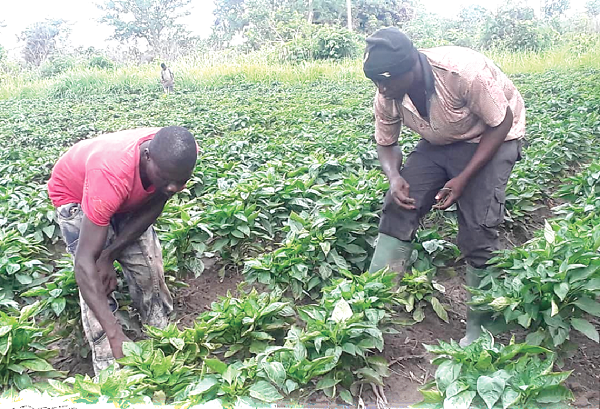
Many farmers in the Bono East Region have switched from maize and yam, cultivating vegetables in commercial quantities to meet the growing market demand for vegetables in the region.
According to Patrick Acheampong, the 2025 Bono East Regional Best Farmer, most of the farmers in the region were cultivating pepper, tomatoes, and garden eggs in commercial quantities.
During a visit to his farm at Tanoso in the Techiman Municipality, Acheampong noted that farmers were producing vegetables, justifying that vegetable production was presently lucrative.
He said the market demand for vegetables had surged at the various markets in the region, saying that had pushed many of the farmers to switch from stable food and cultivating large acres of vegetables.
“In fact, many farmers who left vegetable production have returned seriously looking for land to engage in the cultivation of vegetables in commercial quantities,” Frimpong stated.
Acheampong expressed the fear that the trend could affect maize and yam production in the region, if the situation was properly not well managed.
He said presently the market prices of tomato and pepper were expensive, justifying that a box of tomatoes which used to sell at GHC4,000 was now selling at GHC5,000.
Acheampong said the market price of a bag of pepper which used to sell at GHC6,000 was now selling at GHC9000.
He said vegetable farming was now attractive in the area and called on the government to support the farmers with farm inputs, seedlings and fertilizers.
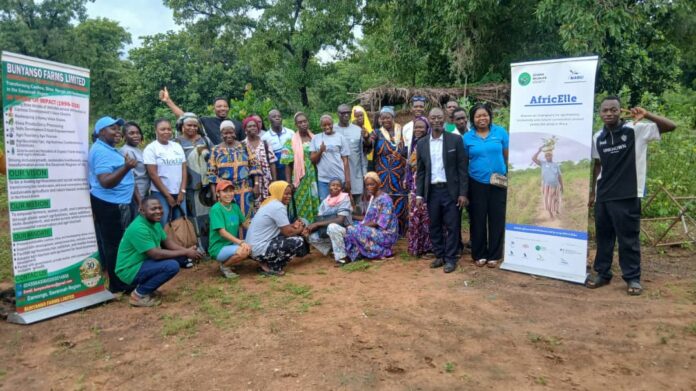
The Ghana Wildlife Society (GWS), together with a delegation of Women Champions and conservation partners from Côte d’Ivoire, has visited Bunyanso Farms Limited to expose the women champions to cashew production, processing, value addition, and integrated agricultural development.
The visit formed part of the Ghana–Côte d’Ivoire Women Champions exchange program under the AfricElle Project, sponsored by NABU. This project provides a platform for Ghanaian and Côte d’Ivoire women to exchange experiences, learn from successful livelihood initiatives and explore practical approaches to strengthening women’s participation in climate-resilient livelihoods, sustainable agriculture and conservation.
During the visit, the Municipal Officer for Women in Agriculture Development (WIAD), Department of Agriculture, West Gonja Municipal, Madam Zubaidatu A. Amidu called for increased participation of women in the cashew value chain.
She highlighted opportunities for women in cashew processing, value addition, agribusiness, entrepreneurship, skills development, access to finance and markets.
Madam Amidu also stressed the importance of creating opportunities for women and young people to benefit from agricultural and agro-processing enterprises.
Mr. Francis Opong, Head of Extension Services at the Department of Agriculture, West Gonja Municipal, explained the importance of effective extension services in improving cashew production and productivity.
He said continuous farmer education and the adoption of Good Agricultural Practices are critical to improving yields, maintaining healthy plantations and promoting sustainable production.
He welcomed the exchange with the Côte d’Ivoire delegation, noting that experiences and lessons from both countries could contribute to strengthening extension delivery and improving the capacity of cashew farmers.
The Chief Executive Officer of Bunyanso Farms Limited and Founder and Executive Director of NORGIID GHANA, Iddrisu Sumani (Azambuja), said the visit provided an important opportunity to demonstrate how agricultural development, women’s livelihoods and environmental conservation can be linked.
He said sustainable cashew production, agroforestry, responsible land management and value addition could improve farmer livelihoods, create employment and contribute to environmental sustainability.
Iddrisu Sumani, also President of the West Gonja District Co-operative Cashew Farmers & Marketing Union Ltd. and a Farmers’ Representative on the Cashew Council of Ghana, expressed appreciation to the Ghana Wildlife Society and the Côte d’Ivoire delegation for visiting Bunyanso Farms.
He said Bunyanso Farms Limited, in partnership with Northern Ghana Integrated Initiatives for Development (NORGIID GHANA), remains committed to working with government institutions, farmer organisations, conservation organisations, private-sector actors and development partners to promote sustainable agriculture, strengthen livelihoods and expand opportunities for value addition.
Mr. Abdulai Abdul Mumin, the General Manager of the Ghana Co-operative Cashew Farmers and Marketing Association Ghana Ltd., Board Member of the Cashew Council of Ghana and Board Member of the Tree Crops Development Authority representing cashew farmers across Ghana, emphasised the importance of strong farmer organisations and effective linkages across the cashew value chain.
He called for stronger collaboration among farmers, government agencies, processors, private-sector actors and development partners to improve productivity, market access and farmer incomes.
Mr. Abdul Mumin highlighted the value of Ghana–Côte d’Ivoire knowledge sharing, particularly in improved production practices, farmer organisation and cooperative development, processing and value addition.
Appreciating the exchange programme, the Côte d’Ivoire delegation, led by Ms. Diabaté Maboridjon of SOS Forêts, and the Ghana Wildlife Society team, led by Dr. Sandra Owusu-Gyamfi, Executive Director of GWS, expressed the importance of continued collaboration and learning between women champions and conservation partners in both countries.
The engagement reinforced the importance of partnerships among community women, conservation organisations, government institutions, farmer organisations and the private sector in developing sustainable livelihood opportunities.
They expressed a shared commitment to applying lessons from the exchange visit in their respective communities and strengthening women-led initiatives that contribute to livelihood improvement, environmental conservation, climate resilience and local economic development.
The delegation explored opportunities associated with cashew apple and kernel processing, as well as the potential for women to participate in processing, packaging, marketing, entrepreneurship and other stages of the value chain.
The experience demonstrated how women can move beyond being producers of raw agricultural commodities to become active participants in processing, value addition and market development.
The visit to Bunyanso Farms Limited, in partnership with Northern Ghana Integrated Initiatives for Development (NORGIID GHANA), therefore served not only as a practical learning experience on cashew production and value addition, but also as an example of how integrated agricultural approaches and strategic partnerships can create opportunities for women and young people while supporting conservation and sustainable development.
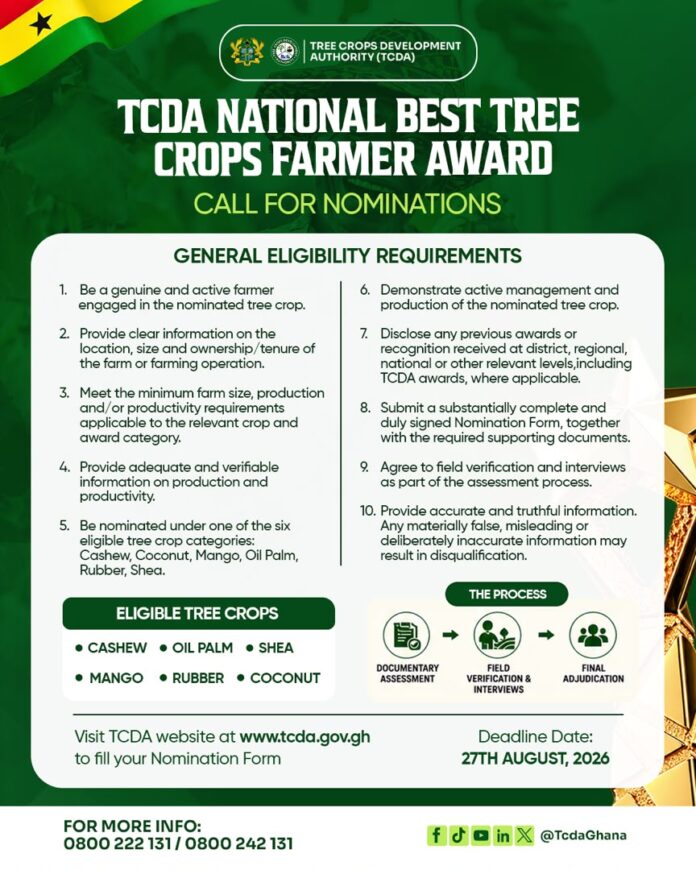
The Tree Crops Development Authority, TCDA, has officially opened nominations for the TCDA National Best Tree Crops Farmer Award.
This is the chance to be recognized on a national stage for the work you do every single day.
who can be nominated? You must be a genuine, active farmer in any of these six eligible tree crop categories; Cashew, Coconut, Mango, Oil Palm, Rubber and Shea then you or someone you know could qualify.
Here’s what TCDA is looking for:
Farmers who are actively managing and producing their nominated crop. Clear and verifiable information on your farm size, location, and ownership.
TCDA requires accurate and truthful information throughout the process. Any false or misleading details could lead to disqualification.
Nomination Process To nominate yourself or a farmer simply visit the TCDA website at www.tcda.gov.gh and fill out the Nomination Form online
Now here’s the important part nominations close on the 27th of August, 2026; so don’t delay!
For more information? Call the TCDA on 0800 222 131 or 0800242444 Or follow TCDA on all social platforms @TcdaGhana for more update Our C-CORMS , Our future
The tree crops, namely cashew, coconut, oil palm, rubber, mango and shea, collectively referred to as CCORMS, contribute significantly to rural livelihoods, employment, household incomes (approximately 1.6 million households), agro-industrial development and Ghana’s export earnings.
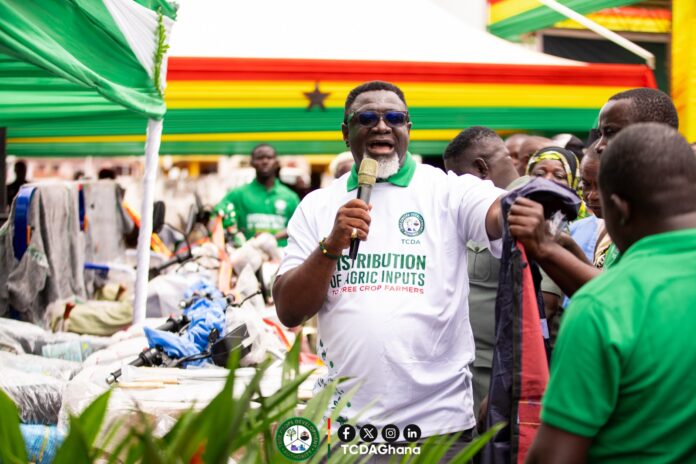
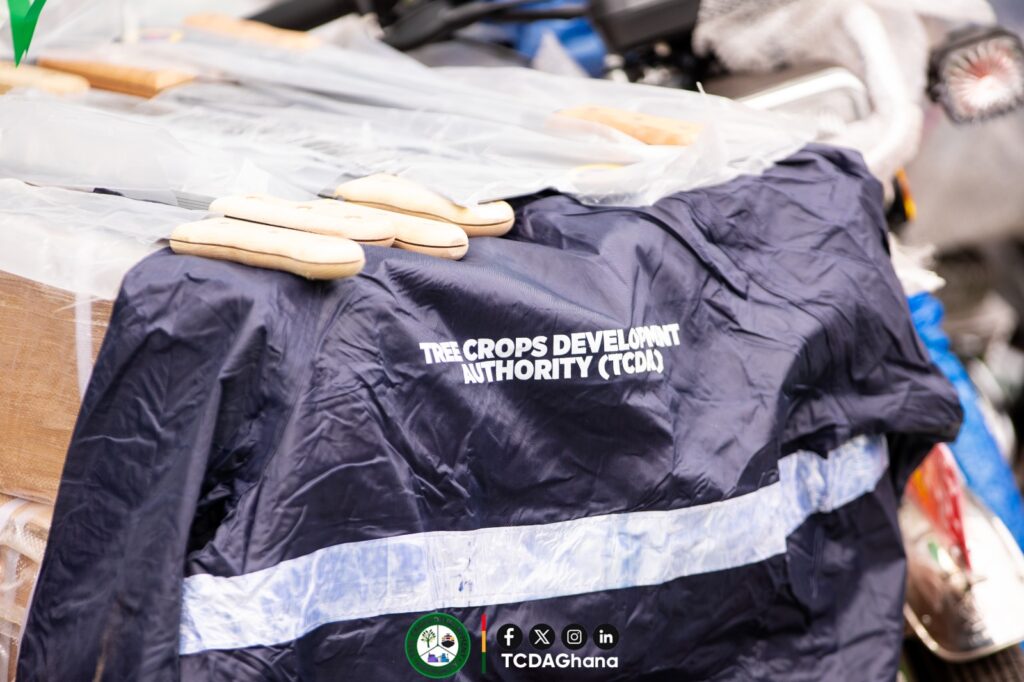
At the handing-over ceremony held at Asante Mampong, the Chief Executive Officer of the TCDA, Dr. Andy Osei Okrah, explained that the inputs distribution demonstrates Government’s renewed commitment, through the TCDA, to improving productivity, farmer incomes, sustainability and value addition within Ghana’s tree crops sector.
The CEO of TCDA, Dr. Andy Osei Okrah, explaining the government’s commitment through the TCDA to improving farmers’ income and livelihoods.
“The nationwide distribution of inputs is therefore aimed at addressing some of the key constraints facing farmers, including limited access to essential production inputs, low productivity, climate-related challenges and inadequate adoption of improved agricultural practices. It forms part of the Authority’s broader effort to build a productive, competitive, resilient and sustainable tree crops sector,” he said.
He extolled the Asante Mampong landscape contributing to Ghana’s agricultural economy and significant potential for the development of tree crops.
Irrespective of the challenges faced by the sector, Dr. Okrah said the sector must develop competitive value chains that move from production at the farm level to processing, manufacturing, branding and access to higher-value markets.
The Chief Executive Officer of the TCDA, Dr. Andy Osei Okrah, demonstrating some of the farm inputs to the farmers.
“This is why the TCDA is pursuing an integrated approach that combines regulation with farmer support, productivity enhancement, research and innovation, market development, traceability, value addition and investment promotion”, he stressed.
He urged the beneficiaries to responsibly put good use of the inputs and follow the recommended agronomic practices while embracing climate-smart, sustainable production systems to improve productivity at the farm level that come with quality inputs, improved planting materials, appropriate technology, extension services and reliable markets.
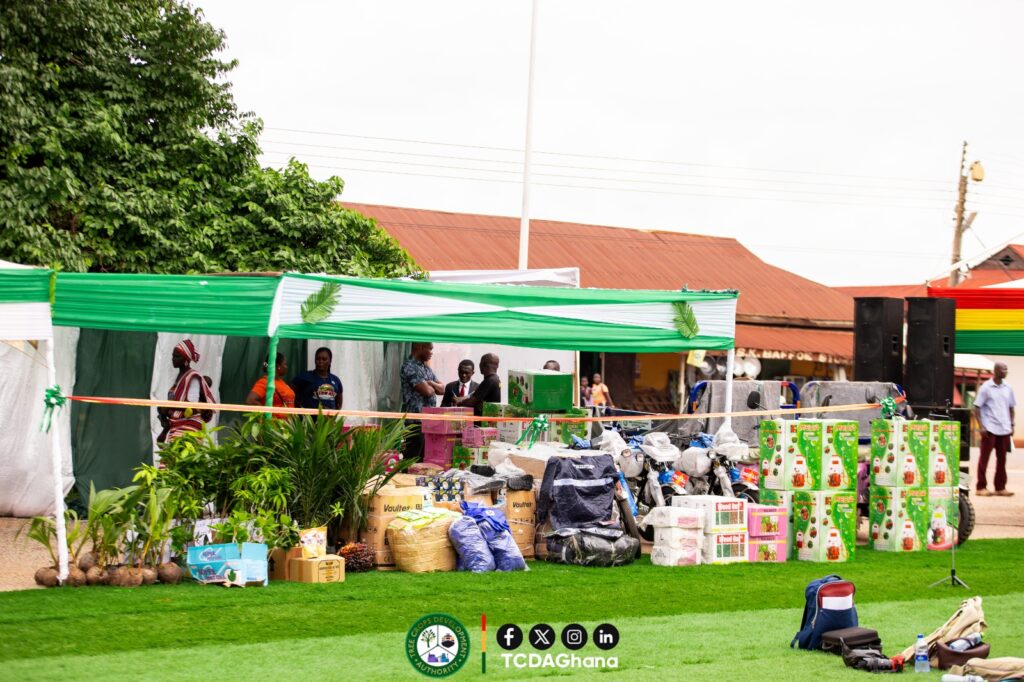
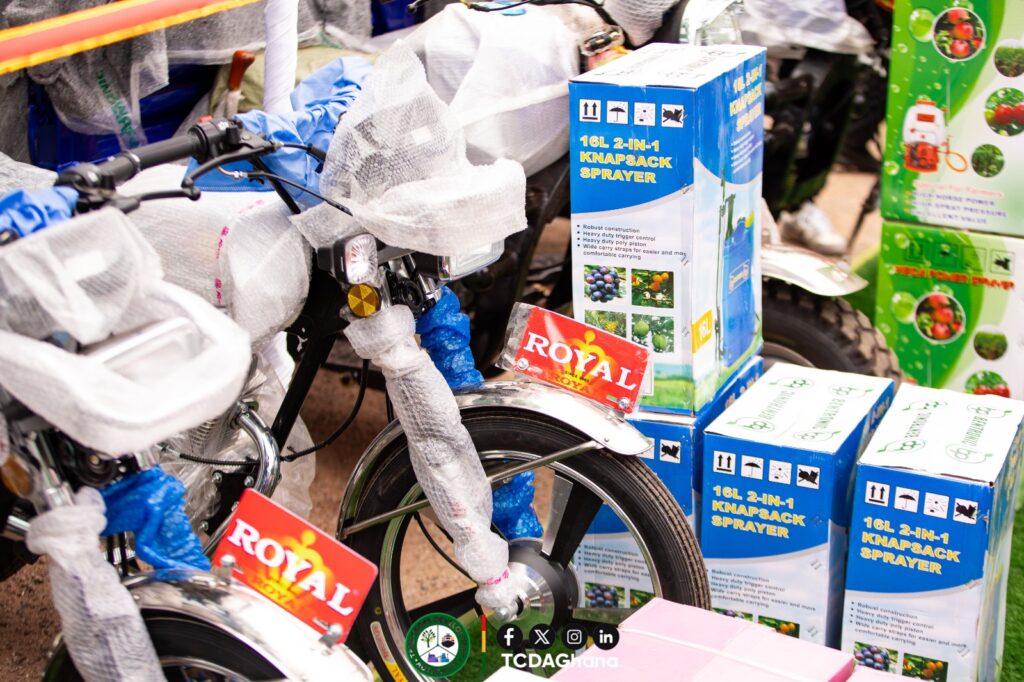
The farm inputs displayed at the grounds to be distributed to the beneficiaries
“We will continue to work with research institutions, development partners, farmer organisations, private-sector companies and local government structures to strengthen extension, research and technology transfer across the six strategic tree crops,” he assured.
He mentioned that the Authority is strengthening farmer registration, mapping and traceability systems to improve planning, service delivery, transparency and accountability throughout the value chain to ensure data and traceability.
He called on the traditional authorities, District Assemblies, farmer organizations, development partners and private-sector stakeholders to continue supporting the national tree crops agenda.
The Tamale Metropolitan Assembly (TaMA) has received and distributed 9,000 50-kilogramme bags of NPK fertiliser and 1,000 bags of urea to selected farmers in the Metropolis to support agricultural production and improve food security.
Mr Adam Abubakari Takoro, Tamale Metropolitan Chief Executive, announced this in his sessional address at the Second Ordinary Meeting of the Third Session of the Ninth Assembly in Tamale.
He said agriculture remained a major driver of the national and local economy, stressing the need for sustained investment to make the sector more attractive, particularly to the youth.
Mr Takoro said the fertiliser distribution formed part of interventions by the Assembly to support farmers and enhance agricultural productivity in the Metropolis.
He also said quantities of birds would soon be received and distributed to households under the Government’s Nkokonkiti initiative.
He said the Assembly was among four Metropolitan, Municipal and District Assemblies in the Northern Region selected for an aquaculture pilot project under the Ministry of Fisheries and Aquaculture Development.
He said about 40 people from the Tamale South and Central constituencies had been selected to receive training, form cooperatives and receive support to establish fish farms.
Mr Takoro said the Assembly was also implementing measures to improve the environmental resilience of the Metropolis and mitigate the effects of climate change.
He said the Assembly targeted planting 150,000 trees under the Government’s Tree for Life initiative to help transform Tamale into a cleaner, greener and climate-resilient city.
He said the Northern Region was expected to plant about 1.2 million trees out of the national target of 30 million trees under the programme.
The Chief Executive said the Assembly, in collaboration with the Dibeni Premier Group, had also commenced the “Shade Dagbang Project” to increase tree cover along major streets, with 176 palm trees already planted along selected principal roads.
He said the Assembly was further implementing the Reset Tamale Initiative in collaboration with PAMEPI Women in Technology Ghana, focusing on climate resilience, water and sanitation, and educational infrastructure.
Mr Takoro, speaking on sanitation, described waste generation, evacuation and disposal as major concerns and encouraged Assembly Members to prioritise monthly National Sanitation Days in their electoral areas.
He said the Assembly would continue to strengthen social protection interventions, including support for persons with disabilities and the Livelihood Empowerment Against Poverty programme.
Mr Takoro highlighted ongoing development projects, including the construction of a 20-bed male ward at the West Hospital valued at GH¢1,812,087.24, and called for stronger collaboration among stakeholders to accelerate development in the Metropolis.