

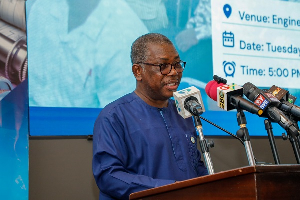
The Ghana Institution of Engineering (GhIE), Ghana’s leading engineering body, has called for the prioritisation of engineering in the quest to make the country food secure.
Delivering a communiqué on the institution’s 56th Annual General Meeting and Engineering Conference in Accra on April 14, 2026, the President of GhIE, Ing Ludwig Annang Hesse, asserted that one of the consensuses reached at the conference was that Ghana can only become food secure if engineering becomes central to the food production value chain.
He indicated that the issues of food security, including post-harvest losses, limited mechanisation, infrastructure gaps, increasing climate variability, as well as inefficiencies in storage and transportation systems, continue to bedevil the country because the role of engineering has not been fully harnessed.
“Food security remains one of the most critical challenges confronting our nation. Across the country, we continue to face significant postharvest losses, limited mechanisation, infrastructure gaps, and increasing climate variability. Inefficiencies in storage, transportation, and processing further compound the situation.
These are not isolated agricultural problems; they are systemic challenges that require deliberate and coordinated engineering solutions.
“One of the most important outcomes of this conference is a clear and unified position: engineering must take its rightful place at the centre of Ghana’s agricultural transformation. For too long, engineering has been treated as a support function within agriculture. That approach is no longer sufficient,” he said.
Ing Annang Hesse stated that it is only through engineering that all the challenges that lead to food insecurity, including climate change, can be resolved.
Engineering is the enabler that connects production to markets, innovation to impact, and policy to measurable results. The conference underscored the need to approach food security holistically across the entire food value chain.
From production systems that depend on irrigation, mechanisation, and precision technologies, to post-harvest management, where the greatest losses occur, the role of engineering is indispensable.
“Without adequate storage, cold-chain systems, and processing infrastructure, the gains made at the production stage are often lost,” he said.
The president went on to present a summary of some key action points from the conference, which was held in the capital town of the Volta Region, Ho, from March 16 to March 20, 2026, on the theme “Engineering the Food Security and Sustainable Agriculture Value Chain,’ as follows:
- Ghana’s food security challenge must be treated as an engineering priority, requiring an urgent but structured national response and action.
- The government should accelerate investment in irrigation systems to enable all-year farming and reduce dependence on rainfall.
- The agriculture sector must shift to mechanisation, technology and data-driven production systems, and must be supported by the necessary incentives and support programmes by the government.
- Road infrastructure must be improved to ensure efficient transportation of farm produce to markets and processing centres.
- There must be major investment in post-harvest systems, including storage, cold chains, and agroprocessing, to reduce losses and boost value addition.
- Renewable energy solutions should be deployed at scale to power irrigation, storage, and agroindustrial activities.
- The country must adopt data-driven and precision agriculture, backed by national systems for soil, climate, and water data.
- Research, local innovation, and circular economy solutions should be strengthened to transform
- waste into energy, fertiliser, and other useful inputs.
- The government should implement policy reforms and innovative financing, including land tenure security and stronger public-private partnerships.
- Investment in people, especially the youth and women, to develop the appropriate skills in engineering, science, technology and agribusiness.