
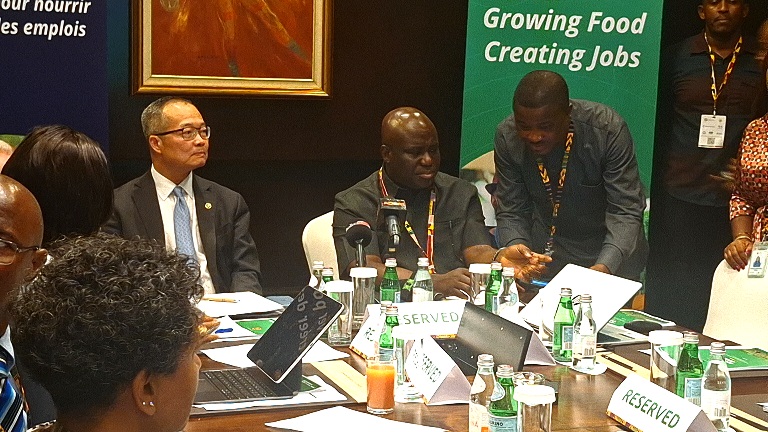
The Minister for Food and Agriculture, Hon. Eric Opoku has launched a transformative agriculture project called AGRICONNECT COMPACT that aims to cut Ghana’s US$3billion import bill and create 2.6million jobs for Ghanaian youth.
AgricConnect is a national framework to strengthen food security, create jobs, reduce food imports, and mobilize investment across priority agricultural value chains.
To alleviate abject poverty and unemployment among the youth, the government launched project called The Agriculture For Economic Transformation Agenda to liberate the youth with the enormous agriculture potentials that Ghana possesses.
To achieve this milestone, the government converged a team made up of all the experts from the various ministries to work on a document that can transform agriculture into agribusiness and create employment opportunities for the you of Ghana, thus AgricConnect.
According to the Minister of Food and Agriculture, Hon. Eric Opoku, the AgriConnect defined some specific crops with mammoth potential to develop entire chains and generate jobs for the youth.
“AgriConnect is about turning Ghana’s agricultural potential into tangible results: more food on the table, more jobs for young people, and more value created here at home. This Compact provides a clear roadmap to modernize agriculture, support farmers, and build stronger value chains that can drive growth nationwide,” Hon, said.
The crops under consideration are; rice, maize, oil palm, cocoa and poultry. The Minister commended the partners for the support and the commitment made towards the implementation of the laudable programme.
“It is our hope that resources required for the implementation of such programme would be made available in time and implementation would proceed effectively so that we can maximize the benefit and realize all the objectives and the goals that are captured in the programme”, he added.
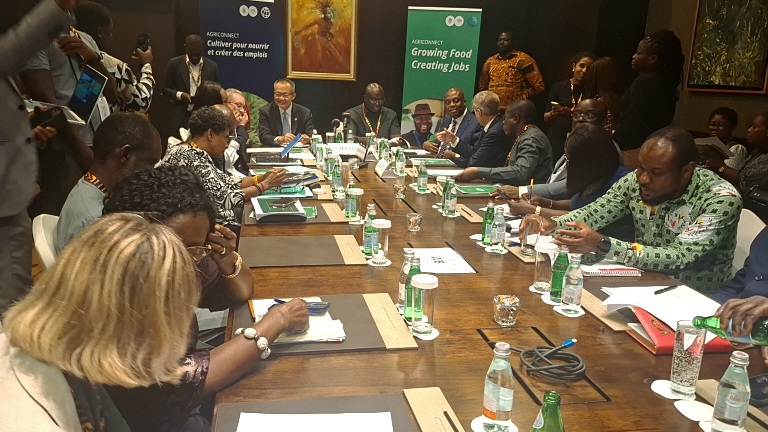
The Remarks from the Partners of AgriConnect:
The World Bank
“Ghana’s AgriConnect Compact is a bold step toward building a more productive, resilient, and jobs-rich food system. By linking policy reform with investment and delivery, Ghana is creating the conditions to strengthen food security, support farmers and agribusinesses, and unlock private capital at scale,” World Bank Group Vice President for Plant, Guangzhe Chen said.
He commended Government of Ghana for the strong leadership and the vision to acknowledge that agriculture is not just about food production, but it’s central to Ghana’s economic transformation for job creation and for resilient agenda.
He underscored the core of the compact that is moving from subsistence to productivity, fragmentation to stronger value chain, and from public-led growth to a stronger private sector investment.
“What makes Ghana’s compact particular compelling is the clarity of its priorities and also the depth of the reforms that it embraces. It focuses on high potential sectors such as cocoa, palm oil, rice, maize, and poultry sector where Ghana has to have a strong comparative advantage and where the potential for job creation and import substitution is enormous,” he extoled.
He mentioned that AgriConnect will focus on six scalable solutions which are; agritech and digital tools, investment in roads, irrigation and infrastructure related, extension services and research, and stronger access to finance.
This effort, he said really reflect the power of partnership with US$3.5billion investment programme for the next 5 years and the strong support from the government with the World Bank Group and its partners of African Development Bank, IFAD, and others.
Ministry of Finance
As key stakeholder of the compact, the Deputy Finance Minister, Hon, Thomas Nyarko Ampem, lauded the government for the proactive step taking to address Ghana’s import bill.
According to him, Ghana imports about two to three billion dollars annually between all food products that can be locally and competitively produced. These represent jobs exported factories never built, value chains left undeveloped, and foreign management unnecessarily drained, therefore, it is exciting to develop the compact that will help reduce and reverse all these trends.
Considering broader agri-food system in the country, Hon. said the sector supports almost 44% of employment nationwide and clearly, no serious economic transformation agenda can therefore bypass agriculture.
He stated that no wonder President has prioritized agriculture through the Feed Ghana program, the Grow24 initiative under the 24-hour economy initiative, the Big Push Infrastructure program, and the broader agro-industrialization strategy.
Giving an account to the funds released to the agric sector, he explained the Ministry of Finance have released about 1.67 billion cedis representing 85 percent of the approved 2026 budget for goods and services, 521 million cedis for 50 Farmer Service Centres to support mechanization, 110 million cedis to be invested in irrigation infrastructures across country, 515.3 million cedis for the supply of fertilizers and certified seeds, 244.9 million cedis to be invested in the poultry farm to table project and 200 million Ghana cedis to be invested by the National Buffer Stock Company.
“Poor road conditions in key production areas limit market access, increase post-harvest losses, raise transport costs, and ultimately reduce farmer incomes. Consistent with our commitment to addressing these structural bottlenecks government is partnering with the World Bank to implement the US$523 million Ghana Market Access and Connectivity Project, farm to market connectivity in selected districts across the country through this intervention we will rehabilitate approximately 1 000 kilometers of feeder roads in major food producing areas particularly those supporting staple crops such as maize rice cassava and yam by improving connectivity between farms markets storage facilities processing centers and logistic corridors”, he added.
He mentioned that AgriConnect affirms the fundamental shift of government’s notion of agriculture. The Compact focuses on strategic value chain that create common framework that align government policy, development partner support, private sector investment, and agricultural financing towards measurable economic outcomes.
Interventions by Stakeholders
Peasant Farmers Association of Ghana
The Former Acting Executive Director of the Peasant Farmers Association of Ghana, Bismark Owusu Nortey lauded the Compact saying it is smallholder-centered initiative.
He mentioned that compact appears to address the respective constraints within the value chain. Currently, he added we all know that when it comes to government, the major issue for our farmers is the issue of markets in the rice mill, yam, cassava, value chains.
He mentioned 3 interventions that the association is interested as the compact is concern. According to him, first, the association is very much interested to see the impacts of the compact to smallholder farmers. At times programs are being run, but the impact is quite imperceptible, therefore the impact of this program should be felt.
Secondly, results should be released on time, and lastly, to have an effective system to monitor and evaluate the progress of the program.
FAGE
The President for the Federation Association of Ghanaian Exporters (FAGE), Narh Korboe said the most critical part of the Compact is the releasing of the funds to the ministry to work with.
He mentioned that delay in release of funds amount to program failure and this has contributed to failure of our new programs.
He admonished that Ghana, especially the Ministry of Agriculture has one of the best agribusinesses personnels in the country, however, the financial muscles to carryout the mandate is always an issue.
“I will be opening my eyes and ears since I have good lens to watch this program”, he concluded.
About AgriConnect
AgriConnect is a World Bank Group initiative to transform farming for 300 million smallholders by 2030. It is supported by partners such as the African Development Bank (AfDB), the Inter-American Development Bank (IDB), the International Fund for Agricultural Development (IFAD), Google and Bayer.
The Ghana AgriConnect Compact is a multi-year national framework focused on strengthening food security, creating jobs, boosting value addition, and mobilizing financing across priority agricultural value chains. The first phase covers 2026–2030 and is aligned with Ghana’s broader goals for agricultural transformation, private investment, and economic resilience.