

African Postdoctoral Fellow at the Alliance of Bioversity International and CIAT, Moureen Nansamba has called on African governments to prioritise research funding in climate-resilient research to bridge the huge gap existing between Africa and the rest of the world.
She made this call when researchers across the globe gathered at the 9th International Plant Phenotyping Symposium, with the theme: “Phenotyping for All; Bridging the Gap in Global Agriculture”
The IPPS N9 was organized by the International Plant Phenotyping Network (IPPN) in partnership with the West Africa Centre for Crop Improvement (WACCI) and was the first IPPS held on the African continent in Accra, Ghana.
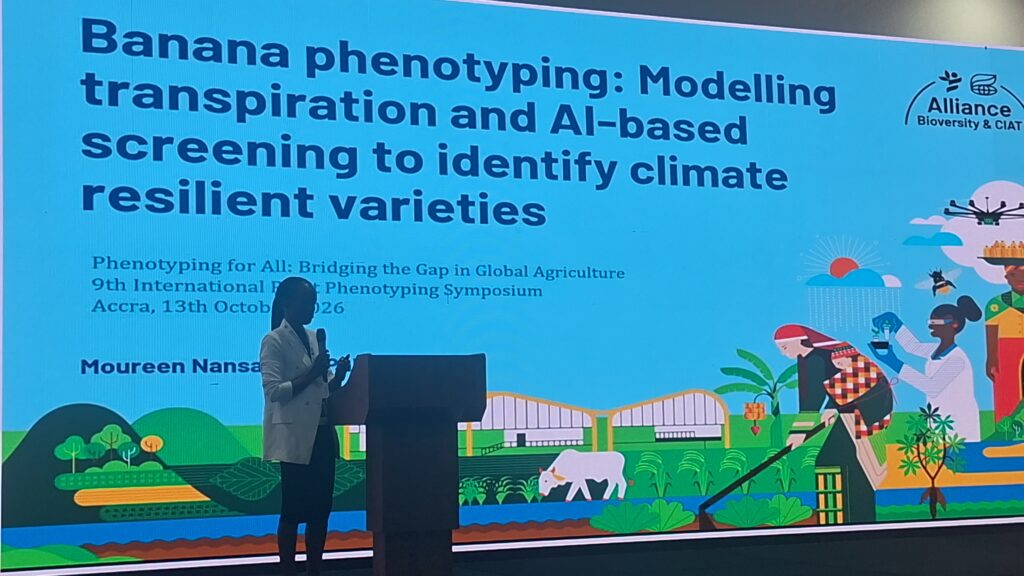
“Whilst our colleagues in the Western world are really advanced in phenomics tools, Africans still lack behind, and that is mainly because Africa’s technology and financial capabilities are very limited”, Moureen Nansamba.
Africa needs to bridge the gap because, with climate change, much faster solutions are required, and Africa can achieve that by employing digital and cutting-edge tools which can accelerate breeding and the development of tolerance varieties that can be used by the farmers in the midst of climate change.
Connecting phenomics, digital and cutting-edge tools to the development of tolerance varieties, Moureen presented that with the AI pipeline, Alliance has been able to quickly identify and also select genotypes that are adapted to specific environments that would be able to conserve diversity in different environments without compromising the resilience of these systems.
“Now with just a cell phone and a lens we can be able to quickly screen and identify which genotypes are drought tolerant and which ones are not, then breeders can then use those droughts tolerant, and introduce drought tolerance in farmer-preferred varieties,” she appreciated the effect of research on phenotyping.

Using types of bananas as a case study to solve food security as a climate-resilient crop in Africa, she mentioned that it has been observed that bananas respond to drought in two ways and have been grouped based on their transpiration behaviour, thus: conservative ones and risk takers.
She explained that the risk takers, also known as East African Highland Bananas, require a lot of water during production and grow very fast. This type of banana is found in the East African Highlands, including parts of the DR Congo as well as Burundi.
Conservative bananas are the ones that require less water and grow slowly. This type is suitable for Sahara places where rainfall is less for production.
“However, the aim is to see how we can then find a genotype that can require much less water but would be able to produce comparable yield”, she added.
This could be achieved when African governments prioritise research funding on the continent.