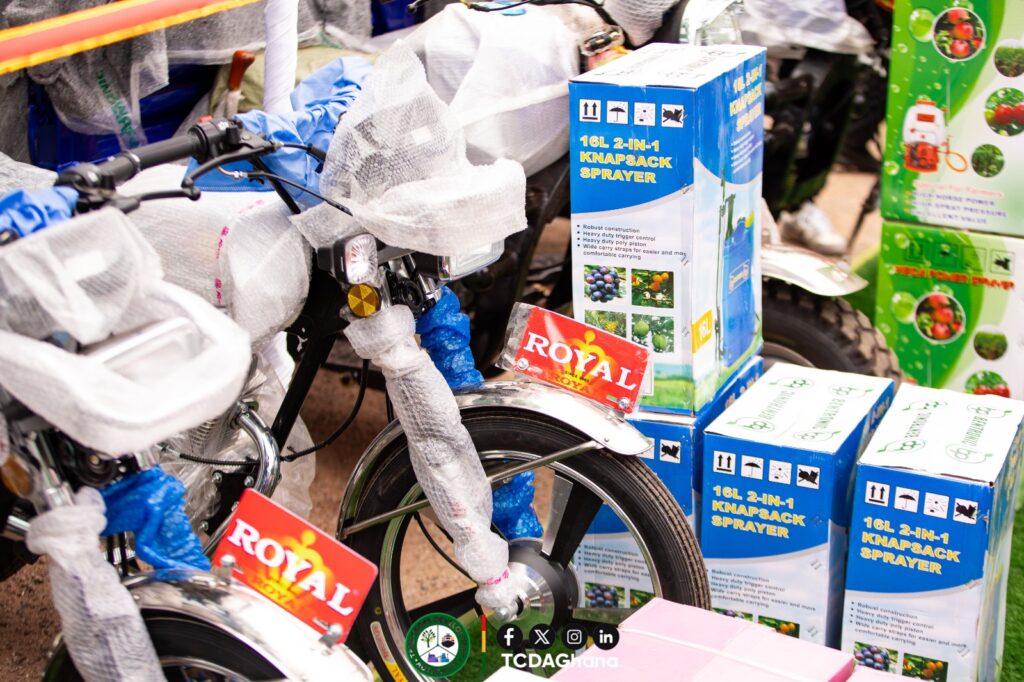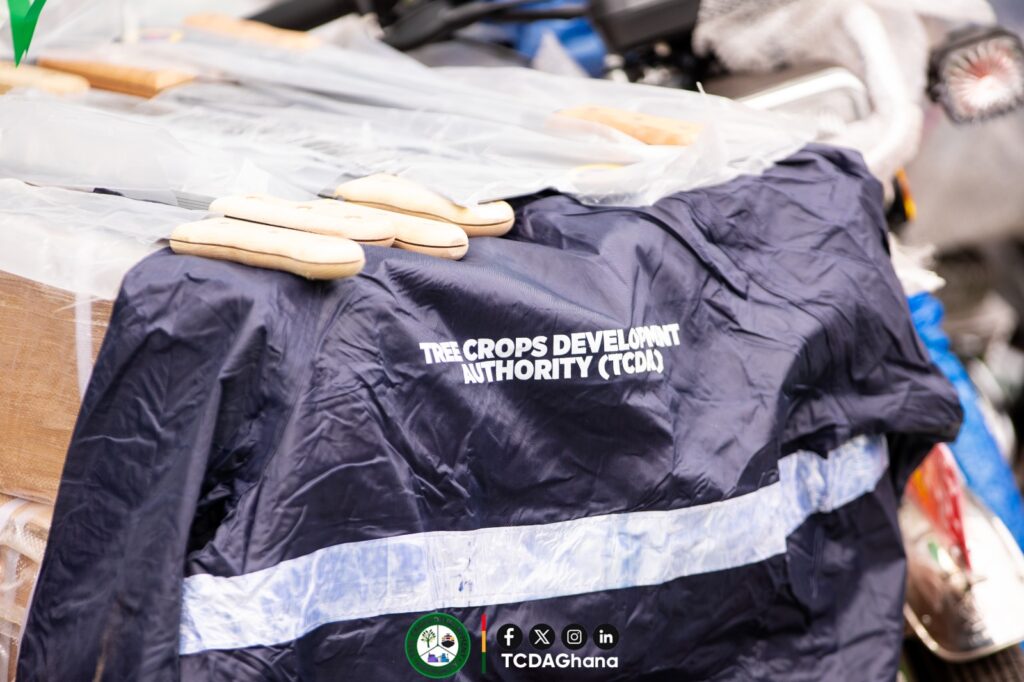


The Tree Crops Development Authority has begun distributing agricultural inputs to tree crop farmers for the 2026 planting season.
Read more: TCDA begins distribution of inputs to improve rural livelihoods of over 1.6 million householdsThe tree crops, namely cashew, coconut, oil palm, rubber, mango and shea, collectively referred to as CCORMS, contribute significantly to rural livelihoods, employment, household incomes (approximately 1.6 million households), agro-industrial development and Ghana’s export earnings.
At the handing-over ceremony held at Asante Mampong, the Chief Executive Officer of the TCDA, Dr. Andy Osei Okrah, explained that the inputs distribution demonstrates Government’s renewed commitment, through the TCDA, to improving productivity, farmer incomes, sustainability and value addition within Ghana’s tree crops sector.

“The nationwide distribution of inputs is therefore aimed at addressing some of the key constraints facing farmers, including limited access to essential production inputs, low productivity, climate-related challenges and inadequate adoption of improved agricultural practices. It forms part of the Authority’s broader effort to build a productive, competitive, resilient and sustainable tree crops sector,” he said.
He extolled the Asante Mampong landscape contributing to Ghana’s agricultural economy and significant potential for the development of tree crops.
Irrespective of the challenges faced by the sector, Dr. Okrah said the sector must develop competitive value chains that move from production at the farm level to processing, manufacturing, branding and access to higher-value markets.

“This is why the TCDA is pursuing an integrated approach that combines regulation with farmer support, productivity enhancement, research and innovation, market development, traceability, value addition and investment promotion”, he stressed.
He urged the beneficiaries to responsibly put good use of the inputs and follow the recommended agronomic practices while embracing climate-smart, sustainable production systems to improve productivity at the farm level that come with quality inputs, improved planting materials, appropriate technology, extension services and reliable markets.

“We will continue to work with research institutions, development partners, farmer organisations, private-sector companies and local government structures to strengthen extension, research and technology transfer across the six strategic tree crops,” he assured.
He mentioned that the Authority is strengthening farmer registration, mapping and traceability systems to improve planning, service delivery, transparency and accountability throughout the value chain to ensure data and traceability.
He called on the traditional authorities, District Assemblies, farmer organizations, development partners and private-sector stakeholders to continue supporting the national tree crops agenda.