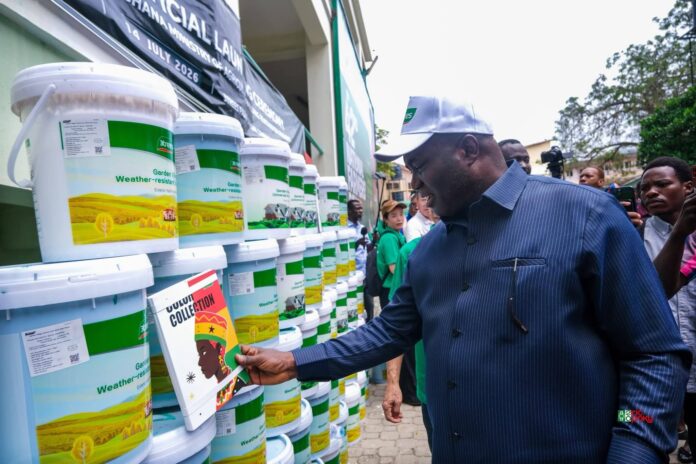
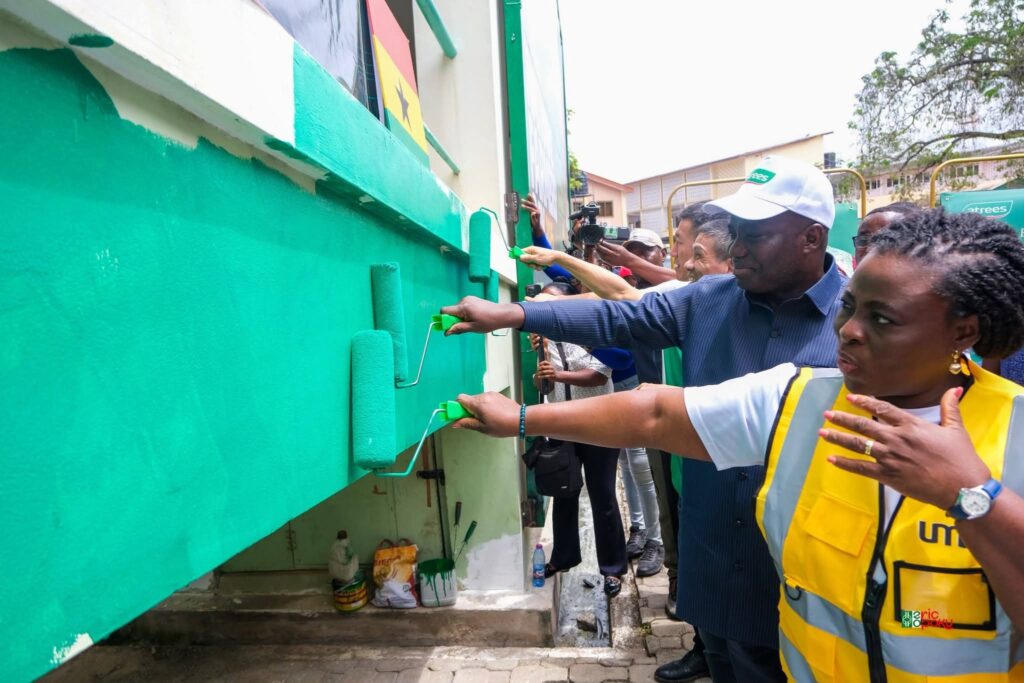
The 3Trees Ghana Paintings is sponsoring the renovation of the national headquarters of the Ministry of Food and Agriculture with an estimated amount of GHS1,068,455 to mark the National Farmers’ Day.
During the official ceremony of the painting at the Ministry’s headquarters, the Minister of Food and Agriculture, Hon. Eric Opoku, lauded 3Trees Ghana Paintings for such a wonderful initiative to renovate and restore the office by painting the entire building at no cost to the ministry.
Minister commended 3Trees for the laudable initiative, “Brightening Ghana Agenda,” which aims to paint government institutions to rehabilitate old structures and modernize facilities in Ghana.
Hon. Eric Opoku, the Minister of Food and Agriculture, exercising his painting skills as 3Trees Ghana Paintings, sponsored the rehabilitation of the office.
He explained that this kind gesture is to encourage the farmers to enhance production and reduce food prices as the farmers’ headquarters is uplifted to its initial stage.
He stressed that the farmers’ day celebration slated for 4th December 2026 at Bono Region is to appreciate and reward the hardworking farmers who work day and night to sustain Ghana’s food security.
He therefore called on stakeholders, institutions, donor partners, and the general public to follow suit and contribute to the celebration by donating to ensure its success.
He assured the 3Trees of effective collaboration to enhance their activities for the goodwill of farmers and Ghanaians.
Violent Lin, the Sales Director of 3Trees Ghana Paintings Limited, extolled the agric ministry for being one of the best ministries under the government’s administration.
As China’s top brand of paintings in Ghana, 3Trees is committed to giving more services to enhance the upliftment of Ghana’s institutions through the Brightening Ghana Initiative.
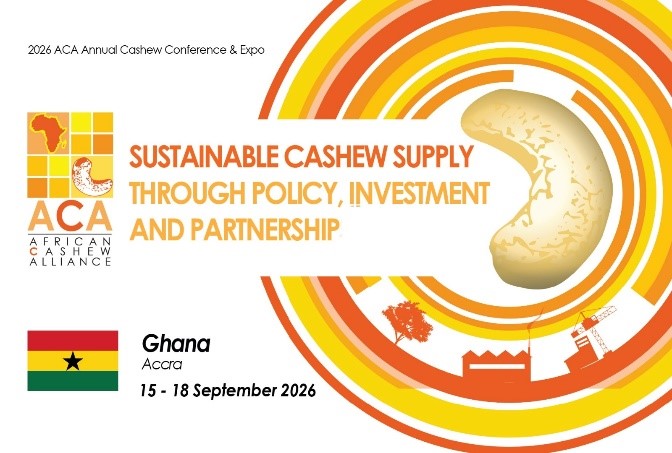
Ghana has been selected to host the 2026 African Cashew Alliance (ACA) Annual Cashew Conference and Expo, marking the second time the country will stage the continent’s flagship cashew industry gathering after previously hosting the event in 2013.
The Conference, scheduled for September 15–18, 2026, will take place at the La Palm Royal Beach Hotel in Accra under the theme, “Sustainable Cashew Supply through Policy, Investment and Partnership.”
Organised by the African Cashew Alliance in partnership with the Ministry of Food and Agriculture and the Tree Crops Development Authority, the event is being supported by the European Union (EU), the Organisation of African, Caribbean and Pacific States (OACPS), and the GIZ/MOVE Project.
In a press statement signed by Isaac Piyuori, in charge of media relations at ACA, more than 600 local and international participants from over 30 countries are expected to attend the four-day conference, which will bring together stakeholders across the cashew value chain, including producers, processors, traders, exporters, buyers, policymakers, development partners, financial institutions, researchers and service providers.
The Conference is expected to provide a platform for discussions on key issues shaping the future of Africa’s cashew industry while creating opportunities for investment, trade and strategic partnerships.
Speaking ahead of the event, President of the ACA Board of Directors, Ibrahim Sanfo, described Ghana’s hosting of the Conference as an opportunity to showcase the country’s progress in the cashew sector.
“The Conference in Ghana presents a unique opportunity to showcase the significant progress made in the country’s cashew sector, attract new investments, promote local processing and value addition, while reinforcing Ghana’s leadership role in Africa’s cashew industry,” he said.
According to the organisers, the 2026 theme reflects growing concerns over ensuring a sustainable and reliable supply of cashew to meet increasing global demand amid changing market and production dynamics.
The Conference will therefore focus on practical approaches to strengthening policy support, increasing public and private sector investment across the value chain, and fostering stronger collaboration among industry stakeholders.
Mr. Sanfo stressed that the industry’s long-term competitiveness will depend on collective action.
“The long-term sustainability of the cashew industry depends on deliberate actions by all stakeholders. Through supportive policies, increased investments across the value chain and stronger partnerships, we can build a resilient, globally competitive and sustainable African cashew industry capable of meeting increasing global demand while improving livelihoods and creating shared prosperity,” he said.
The programme will feature presentations, high-level panel discussions, technical workshops, thematic forums and information sessions led by industry experts and practitioners.
Key discussions will focus on production sustainability, financing and investment opportunities, policy and regulatory frameworks, market trends, value addition, quality and food safety standards, climate resilience and strategic partnerships.
The event will also facilitate business-to-business (B2B) meetings aimed at fostering new commercial relationships and strengthening existing partnerships across the global cashew industry.
In addition, the ACA Expo will showcase cashew products, technologies, innovations and services from organisations operating across the international cashew value chain, providing exhibitors with opportunities to engage prospective investors, buyers and partners.
About the African Cashew Alliance
The African Cashew Alliance was established in 2006 as an association of African and international businesses committed to promoting a globally competitive African cashew industry. Today, ACA members represent all segments of the cashew value chain, including producers, processors, traders, exporters and international buyers.
Achieving youth-inclusive agrifood systems requires expanding economic opportunities, equipping young people with the necessary skills and resources, including access to quality education and training, and facilitating their access to productive resources.
Ghana’s agrifood systems present significant opportunities for economic transformation, particularly through increased participation of young people and women. However, despite growing interest in agribusiness, youth engagement remains constrained by structural barriers, including limited access to regional markets, inadequate knowledge of cross-border trade processes, and weak coordination between policy frameworks and implementing institutions.
It has become evident that young people need agrifood systems just as much as agrifood systems need young people. According to the FAO report, The Status of Youth in Agrifood Systems outcomes: Strengthening the Evidence for Youth-Inclusive Agrifood Systems, involving young people in policymaking and safeguarding their future within agrifood systems can generate significant gains.
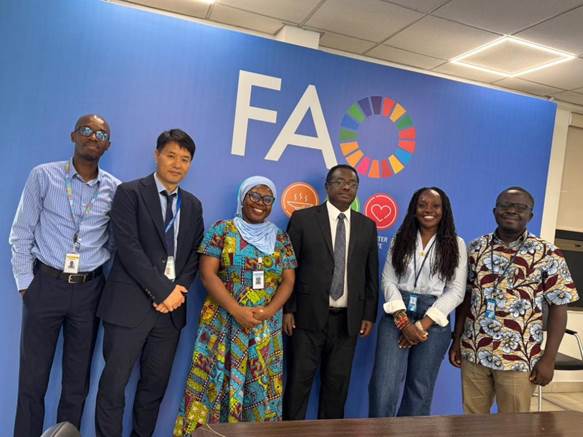
Anthony Aidoo, WFF Ghana Chapter Steering Committee, Alberta Nana Akyaa Akosa, WFF Ghana Chapter National Lead, with Dr. Abebe Haile-Gabriel, FAO Assistant Director-General, Janetta Carlucci, FAO Regional Youth Specialist, Jung-hyun Kim, FAO Regional Partnership Specialist, and Caesar Vulley, FAO Youth Employment Social Policy Officer, at the FAO Regional Office in Accra
Although youth employment in agrifood systems has declined over time because of reduced agricultural employment, youth inclusivity within Ghana’s agricultural sector, agribusiness, and the broader agrifood system is steadily gaining momentum as stakeholders and policymakers intensify efforts to empower young people and position them at the center of agricultural transformation.
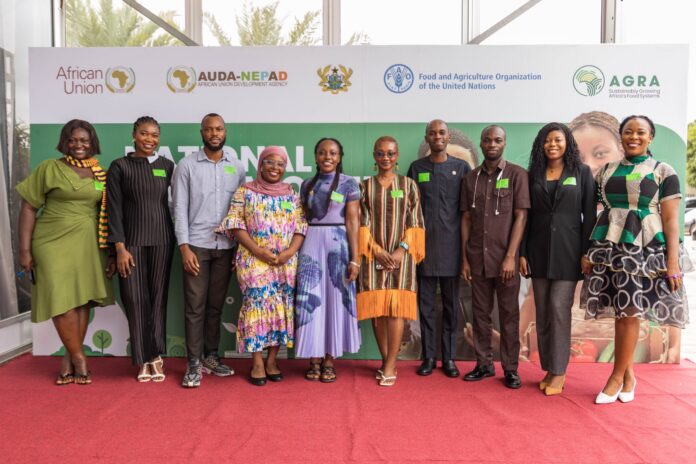
In line with efforts to increase youth participation and inclusivity, AGRA and FAO organized a National Youth Dialogue, focusing on strengthening youth participation in agribusiness through the African Agribusiness Youth Strategy (AAYS) and the Youth in Agrifood Systems Performance Index (YAPI) pillars.
A key outcome of the dialogue was the call by Member of Parliament of Wa East Constituency and Chairman of Parliamentary Select Committee on Food and Agriculture, Hon. Dr. Godfred Seidu Jasaw, for young people to come together to establish a nationwide youth-led movement that would serve as a strong advocacy platform for youth inclusion in agricultural policy development and implementation, by recognizing and highlighting the needs of young people and encouraging their participation in policy, regional and continental market trade.
The Ghana Chapter of the World Food Forum is fully aligned with this call, as the goal for which the FAO initiated the World Food Forum is to drive a nationwide youth movement in agrifood systems.
The Chapter’s active participation in the National Youth Dialogue has further strengthened its position to lead and drive this call for a unified youth-led movement that speaks with one voice.
The World Food Forum (WFF) Global Youth Action Initiative is a global platform for youth engagement that brings together young people from around the world to drive action for more sustainable, inclusive and resilient agrifood systems. Through a growing network spanning 62 countries and reaching tens of thousands of young people, the WFF Youth Initiative supports youth-led action and empowers the next generation of change-makers to contribute to agrifood system transformation.
Stationed within the Office of Youth and Women (OYW) at FAO headquarters in Rome, the WFF serves as a dynamic platform that empowers young people to transform agrifood systems for a better food future through its five thematic programmes: Youth Assembly, Youth Innovation Lab, Youth Education, Youth Culture and Local Youth Action.
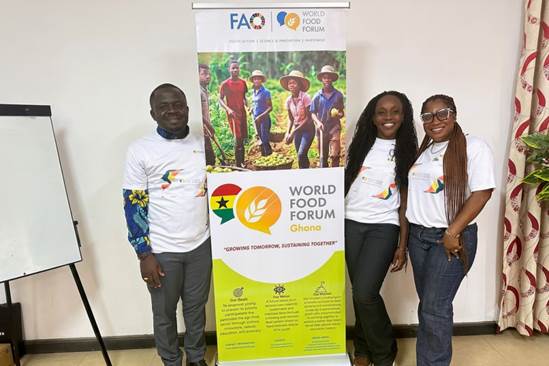
WFF Ghana Chapter Founding Members, Anthony, Alberta, and Phillipa Mensah.
The Ghana Chapter of the World Food Forum (WFF) was established in Ghana in 2024. The Chapter is steadily growing and positioning itself as one of the strongest youth-led agrifood systems movements in Ghana by harnessing the innovative capacities of Ghanaian youth across all 16 regions to identify grassroots solutions and inspire positive action for the country’s agrifood systems.
Guided by and aligned with the principles of the World Food Forum Office of Youth and Women in Rome, which serves as a leading youth platform for global food governance and a think tank promoting youth-led solutions in science, innovation, technology, culture and advocacy, the Ghana Chapter is leading conversations and connecting young people through strategic local, national and global activities.
With a growing membership, the Ghana Chapter has over the years undertaken and continues to implement projects and activities across the regions through its well-established Regional Focal Representatives and working groups.
The World Food Forum Ghana Chapter currently has Regional Focal Representatives in 11 of Ghana’s 16 regions, namely the Ashanti, Greater Accra, Western North, Volta, Oti, Bono East, Northern, Upper East, Upper West, Bono and Central regions.
These representatives coordinate regional activities, engage young people, facilitate partnerships and support the implementation of the Chapter’s programmes at the local level.
The Ghana Chapter has also established working groups within its structure to drive youth-focused programmes. These include the Research, Innovation and Culture Working Group; the Social Protection and Women Inclusion Working Group; the Agribusiness and Entrepreneurship Working Group; the Health and Nutrition Working Group; and the Livestock, Fisheries and Aquaculture Working Group.
In the coming months, additional working groups will be introduced to focus on Agronomy, Horticulture and Mechanization, Forestry and Wildlife, Agroforestry, and Carbon Markets.
The working groups comprise dedicated members who lead discussions and initiatives within their respective focused areas.
Sitting at the helm of the affairs and operations of the Ghana Chapter of the World Food Forum is the National Steering Committee, led by the Steering Committee Chair, the National Lead, the Projects Lead and the Social Protection Lead.
All four Steering Committee members are part of the founding members of the Chapter in Ghana, spearheading and overseeing its activities to ensure the smooth implementation of the Chapter’s youth-centered policies while advocating for greater youth inclusion and creating awareness of the need to ensure that no one is left behind.
The founding members and leadership of the Ghana Chapter include Anthony Aidoo, Founder and Steering Committee Chair; Alberta Nana Akyaa Akosa, Co-founder and National Lead; Philipa Mensah, Founding Member and Social Protection Lead; and Elliot Mensah, Founding Member and Research and Education Lead.
Beyond driving the youth inclusion agenda in Ghana, the Steering Committee has had the privilege of representing the Ghana Chapter on global platforms to champion youth action, with the strong support and backing of the Food and Agriculture Organization of the United Nations (FAO).
Among the key international events in which the Chapter participated was the historic 34th Session of the FAO Regional Conference for Africa (ARC34), where, for the first time in the Conference’s history, young people from across Africa were officially represented. The WFF Africa Chapters actively engaged over 489 participants including Ministers responsible for Food and Agriculture from the 51 African member countries, demonstrating FAO’s commitment and deliberate efforts to promote meaningful youth inclusion and accountability in agrifood systems.
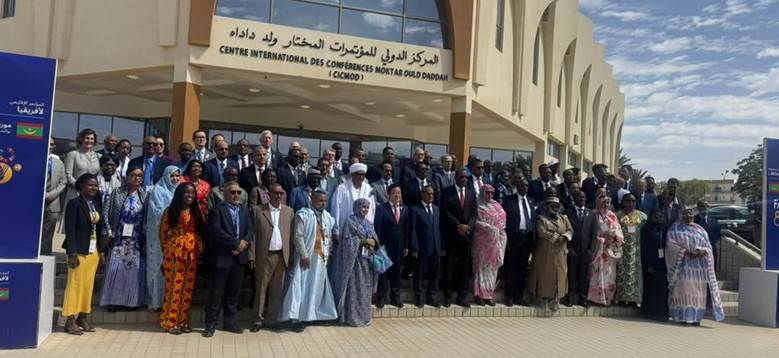
Group picture of policy makers, stakeholders, at the 34th Session of the FAO Regional Conference for Africa (ARC34)
In 2025, the Ghana Chapter, together with FAO, took center stage to present the Status of Youth in Agrifood Systemsoutcome report at the Africa Food Systems event in Senegal. FAO’s intentional approach to advancing youth inclusion through the World Food Forum Chapters across the globe remains one of the most practical models for securing the future of food systems.
The Ghana Chapter has also participated in the annual World Food Forum flagship event in Rome with support from FAO. Held every October, the flagship event brings together more than 20,000 young people from around the world to exchange ideas, share innovations and develop practical solutions for transforming agrifood systems.
FAO is demonstrating in practical terms that young people can be active participants at every stage of the food and agricultural value chain through the World Food Forum Chapters. We therefore encourage young people across Ghana to come on board and join the World Food Forum Ghana Chapter.
The call by the Chairman of the Parliamentary Select Committee on Food and Agriculture, Dr. Jasaw, for Ghana to champion an inclusive youth-led agrifood systems movement resonates strongly with the vision of the World Food Forum Ghana Chapter. In the coming months, the Chapter will engage the various Parliamentary Select Committees to further strengthen collaboration and develop pathways for aligning our activities with national policy priorities.
WFF Ghana Chapter with Accra Academy students on International Youth Day
Currently, the Ghana Chapter of the World Food Forum has over 800 members spread across all 16 regions of Ghana. Our immediate focus is to strengthen this growing membership base by investing in more localized and practical approaches that keep members actively engaged through innovative initiatives and programmes.
Earlier this year, the Chapter held its Second Annual Youth Assembly, bringing together members, Regional Focal Representatives and Working Groups to review progress, assess achievements and develop strategies that will shape the Chapter’s future conversations, programmes and activities.
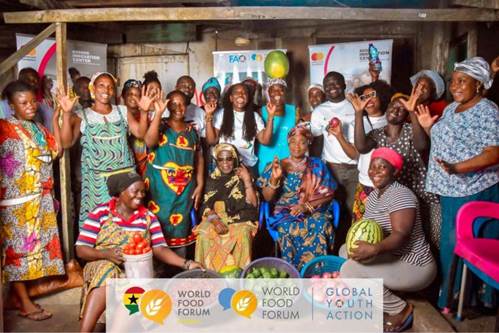
The Chapter has also organized several key activities across the country, including the Traditional Market Women and Traders’ Symposium at Agbogbloshie, which brought together more than 150 traders to engage with young people on strengthening agrifood systems and addressing critical barriers affecting local food markets.
WFF Ghana Chapter National Steering Committee with some women traders in Accra
As part of the International Youth Day celebrations, the World Food Forum (WFF) Ghana Chapter engaged more than 500 students at Accra Academy Senior High School, inspiring and equipping them with the knowledge and tools needed to transform Ghana’s agrifood sector while encouraging them to contribute actively to food security and sustainability.
Through a Farmers’ Symposium held at Fumso Ketewa in the Adansi Asokwa District of the Ashanti Region, the Chapter also took a bold step in demonstrating that agriculture can be profitable when managed as a business. The symposium brought together 73 participants from surrounding rural communities.
The Chapter also organized a major women empowerment and youth-led dialogue at the University of Energy and Natural Resources (UENR). Titled, “What It Takes to Empower the Young Ghanaian Woman in Agrifood Systems Through Youth-Led Actions,” the event attracted 150 participants, including students, early-stage agripreneurs and young professionals, to amplify the voices of young women in agrifood systems transformation.
The Chapter also partnered with the FAO Country Office in Accra to host a fisheries and livestock event promoting local production in the Volta Region.
The Ghana Chapter has further partnered with key organizations, including the Ministry of Food and Agriculture and Agrihouse Foundation, to host Ghana Poultry Day, an annual event that brings together stakeholders across the poultry value chain to develop and recommend measures for promoting local poultry production and consumption.
In line with the recognition of 2026 as the International Year of the Woman Farmer, the World Food Forum Ghana Chapter has once again partnered with Agrihouse Foundation and Agriwatch GH News Portal to produce a documentary series highlighting and celebrating the outstanding contributions of women farmers, including women farmers with disabilities, to the development and sustainability of Ghana’s agrifood system. The documentary is currently shown weekly as docu-series on prominent media outlets’ online pages ad websites including Ghana News Agency (GNA), Asaase 99.5 FM, Asaasepa 107.3 FM, Agriwatch GH, and Business and Financial Times (BFT).
The Chapter is also implementing a school farm project, beginning with Accra Girls Senior High School, as part of the AgriXperience School Project to enhance food production and availability in Senior High Schools.
Members of the World Food Forum Ghana Chapter enjoy numerous opportunities, including networking with industry leaders and fellow young professionals; access to valuable resources, information and learning materials; participation in national and international events and conferences; leadership development opportunities; professional and organizational growth; increased visibility and recognition; training, mentorship and capacity-building programmes; as well as access to strategic partnerships and collaborative opportunities.
The World Food Forum Ghana Chapter welcomes all young people, students, agripreneurs, researchers, development practitioners and stakeholders who are young at heart and passionate about transforming Ghana’s agrifood system to join this growing youth-led movement.
Hand in hand, we can strengthen youth participation, influence policy, promote innovation and build a sustainable food future for Ghana, ensuring no one is left behind.
The Ministry of Food and Agriculture and Ghana Irrigation Development Authority (GIDA), in partnership with Jolly Homes, an estate development firm, are to redevelop the Amranhia Dam into a multipurpose functional dam.
The Dam, which takes its source from the Aburi mountains, serves as a source of irrigation for the smallholder farmers, ranchers, and the aquaculture sector in the enclave.
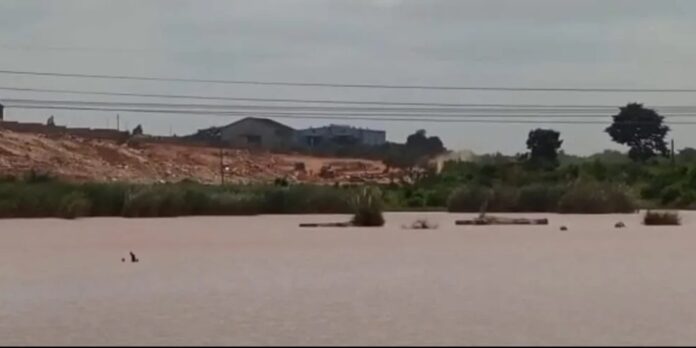
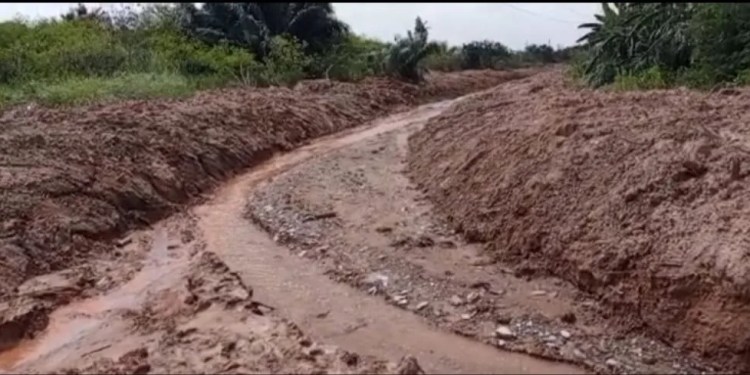
Due to the encroachment on the dam banks and the activities of the sand mining near the dam, it has become difficult for the dam to serve its intended purpose.
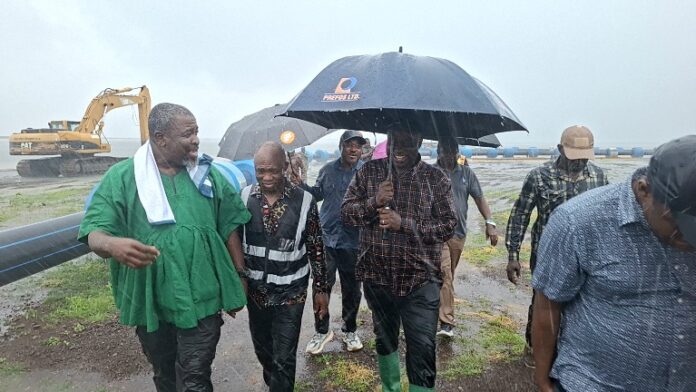
To avert further deterioration of the dam and make it useful for irrigational, aquaculture and recreational purposes, a delegation was sent by the Minister from the Ghana Irrigation Development Authority’s monitoring and evaluation team, the media and Jolly Homes to tour the dam site to assess the waning condition of the dam.
During the dam tour, the Head of Department for the Adenta Municipality of Agriculture, Rosemond Adjeoda extolled the Minister to redevelop the dam.
According to her, the dam provides clean water for both agricultural and aquaculture purposes, particularly to the vegetable farmers.
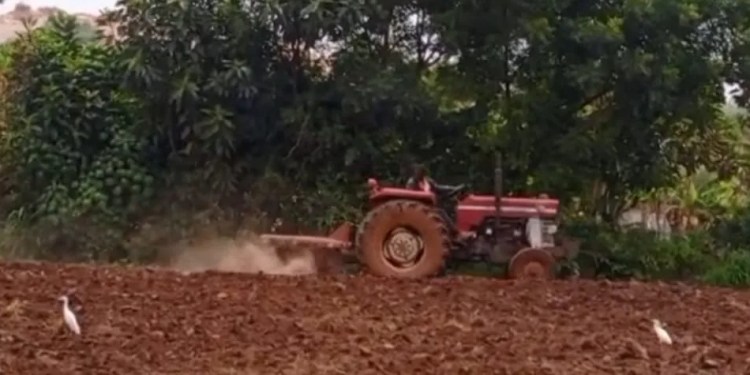
A beneficiary smallholder farmer is preparing his farmland to cultivate near the dam.
“This water is very clean, and it’s been used by the vegetable growers at this enclave. At other places, they use wastewater from places which make the food crops repugnant; however, it is incredible for the Minister to redevelop this dam for us”, she added.
She underscored the significance of the dam to the cannery factory as the only source of water the factory uses.
The Deputy Director in charge of Scheme Oversight of GIDA, Joseph Nartey, explained that the team is to monitor and evaluate the dam to complement the survey, engineering works, and designs that have been established earlier.
The Deputy Director in charge of Scheme Oversight of GIDA, Joseph Nartey, explained the actual work that needs to be done at the dam site.
Giving the actual work that needs to be done at the dam site, he said, dredging the dam to restore its depth and improve water storage capacity, making it effective for irrigation, aquaculture, and recreation.
He cautioned the encroachers on the dam, especially those who had built upstream, to evacuate since the buildings would be demolished during the redevelopment of the dam.
He assured of ceasing the operations of sand winning and gravel excavators that have caused debris and mud to accumulate in the dam.
He refuted a circulated publication by some of the social media houses indicating an encroachment of the dam by an estate developer.
“From the site plan, the estate is not sitting in the dam. What we saw was that part of the estate’s land is within the catchment area and, per the agreement, is using that catchment as a swimming pool, but not to build houses”, he refuted the claim.
He commended Jolly Homes for financially supporting the redevelopment of the dam to serve irrigational, aquaculture, and recreational purposes.
Emmanuel Osei Amankra, the Operations Manager of Jolly Homes, added that the viral images shared online had been edited to create a misleading impression, inciting the homes sitting in the waterways; however, the actual condition on the ground is different.
“We all know the issues of flooding that have befallen this country, and as a result, a lot of people are agitated, including myself, because we don’t want to block waterways or whatsoever. However, people have taken advantage of this issue and misrepresented things. Unfortunately, Jolly Homes became a victim of that. Someone took shots of this place, edited it, and posted it on social media for it to sound as if we are sitting on a waterway; that is not the issue”, he lamented.
He stated that the company has no intention of encroaching on the waterways; rather, it intends to partner with the government to redevelop the dam for the benefit of commuters.
He urged the public to debunk the misleading pictorial publication that tends to tarnish the image of the company.
As a financial partners, he said the total amount for the project and the project timeline cannot be disclosed since detailed engineering and design works are still ongoing.
The Federal Government will next Tuesday host Cameroon, Côte d’Ivoire and Ghana in Abuja for a landmark summit where the four countries will launch a historic alliance to end decades of exporting raw cocoa beans and begin negotiating with global markets as a united bloc.
The four countries, which together account for about two-thirds of global cocoa production, are expected to sign the Abuja Declaration at the Cocoa Value Addition Summit 2026 in Abuja, establishing a Cocoa Value Addition Alliance to coordinate policies, promote local processing, harmonise standards and strengthen Africa’s bargaining power in the global cocoa industry.
Nigeria will also sign a separate Cocoa Value Addition Accord, a national compact that will bring together the federal government, governors of cocoa-producing states, farmer organisations, industry groups, researchers and development finance institutions to deliver measurable improvements in cocoa processing, farmer incomes and investment.
The development was disclosed in a statement issued on Friday by the Special Assistant, Media Office of the Minister of State for Industry, Odenke Ibiang in Abuja.
According to the statement, the summit, themed “From Bean to Brand,” represents a turning point for Africa’s cocoa industry as producing countries seek to retain more value from the commodity instead of exporting raw beans for processing abroad.
The statement read, “The countries that grow most of the world’s cocoa will gather in Abuja on Tuesday to declare that the century of exporting raw beans is over.
“At the Cocoa Value Addition Summit 2026, convened by the Federal Government of Nigeria under the theme From Bean to Brand, delegations of Cameroon, Côte d’Ivoire, Ghana and Nigeria will sign the Abuja Declaration, establishing a Cocoa Value Addition Alliance through which the four nations, the source of some two thirds of global cocoa production, will negotiate, set standards and engage world markets as one bloc.”
Speaking ahead of the summit, the Minister of State for Industry, Senator John Owan Enoh, said African cocoa-producing countries were determined to change a century-old trade model that has left producing nations with little economic value despite supplying most of the world’s cocoa.
“For a hundred years, Africa has sent its cocoa to the world in sacks and received it back in wrappers, paying at both ends of the transaction,” said Senator John Owan Enoh, Honourable Minister of State for Industry, who will host the Summit.
“The distance between a bean and a brand is measured in jobs and in dignity, and on Tuesday, in Abuja, four nations begin closing that distance together. We do not gather to lament the market. We gather to redesign our place in it,” he added.
The minister, who is also a cocoa farmer from Cross River State, is expected to deliver the keynote address during the summit.
According to the organisers, the newly proposed alliance will enable the four countries to negotiate collectively with international buyers, coordinate industry standards and adopt common positions on issues affecting the global cocoa trade.
One of the immediate priorities of the alliance will be the implementation of the European Union Deforestation Regulation, which comes into effect for large and medium-sized operators on December 30, 2026.
Under the regulation, cocoa exported into the European Union must be fully traceable to individual farms, with proof that production did not contribute to deforestation.
The alliance is expected to adopt a unified position calling for recognition of national traceability systems while insisting that the cost of compliance should not be transferred to smallholder farmers.
The statement noted that the summit comes at a particularly volatile period for the global cocoa industry, with international prices fluctuating sharply over the past 18 months.
It observed that global cocoa prices surged to record highs above $11,000 per tonne before falling to about $3,000 per tonne and later recovering to around $5,000 per tonne, creating uncertainty for producers and exposing farmers to severe income fluctuations.
As part of Nigeria’s commitments, the Cocoa Value Addition Accord will establish measurable targets for expanding domestic cocoa processing, increasing farmers’ earnings, attracting new investments and strengthening the country’s cocoa value chain.
Implementation of the agreement will be supervised by a delivery council chaired by the Minister of State for Industry, while progress reports will be published annually to ensure transparency and accountability.
The summit will also feature goodwill messages from the Ghana Cocoa Board and Côte d’Ivoire’s Le Conseil du Café-Cacao.
A special financing session involving the Bank of Industry, the Nigeria Incentive-Based Risk Sharing System for Agricultural Lending and other development finance institutions is also expected to produce major financing announcements for the cocoa industry.
Participants will equally receive updates on the construction of what is expected to become Nigeria’s largest cocoa processing facility, a 70,000-metric-tonne processing plant being developed by Sunbeth Global Concepts in Sagamu, Ogun State, which is scheduled for commissioning in 2027.
The Cocoa Value Addition Summit 2026 is being organised by the Federal Ministry of Industry, Trade and Investment through the Office of the Minister of State for Industry, with the Bank of Industry serving as co-convener.
The statement added that the event forms part of the implementation of the Nigeria Industrial Policy under the Tinubu administration, which identifies agro-industrial value addition as a key strategy for economic diversification, industrialisation, export expansion and job creation.
Nigeria is the world’s fourth-largest cocoa producer after Côte d’Ivoire, Ghana and Indonesia, while Côte d’Ivoire and Ghana together account for more than half of global production.
Despite producing most of the world’s cocoa beans, African countries earn only a fraction of the value generated by the global chocolate industry because the bulk of processing, manufacturing and branding takes place in Europe and other developed economies.
The proposed Cocoa Value Addition Alliance is expected to reverse that trend by encouraging greater local processing, expanding manufacturing capacity, improving farmers’ incomes and increasing Africa’s share of the global cocoa value chain.
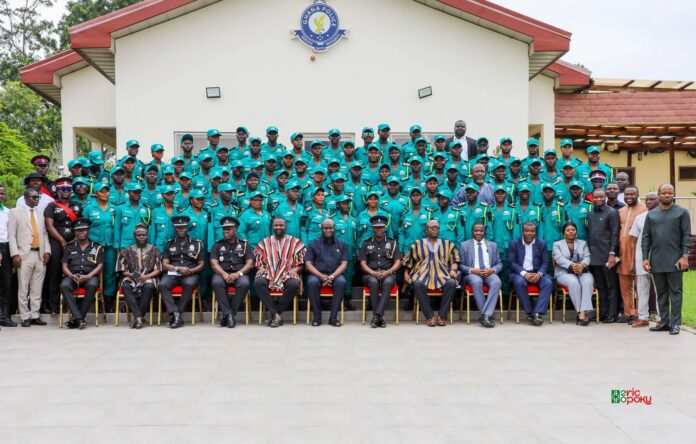
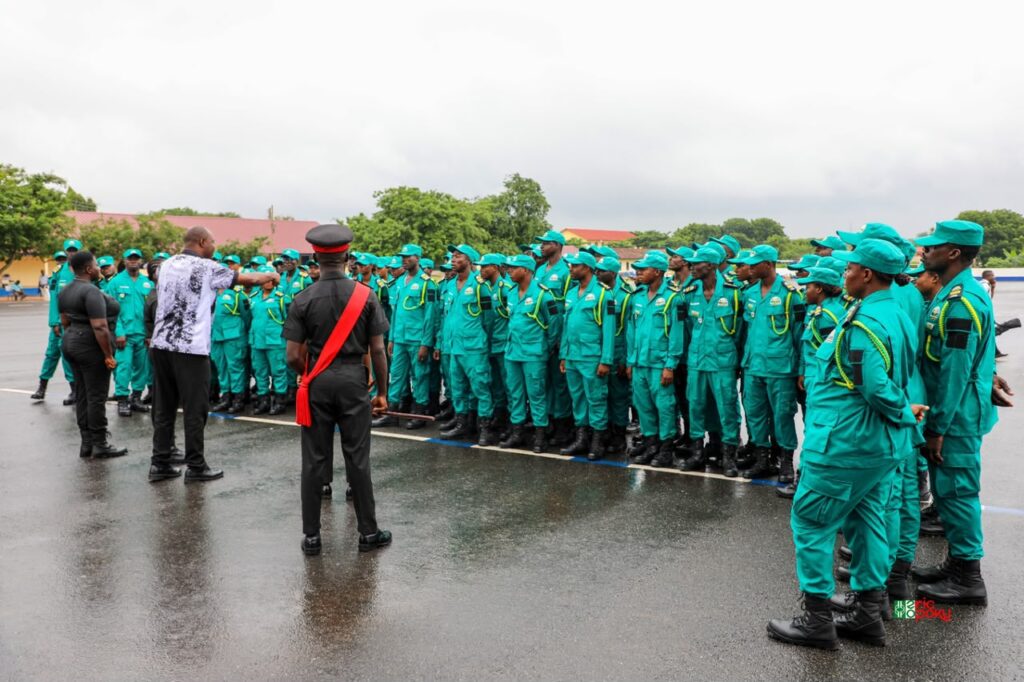
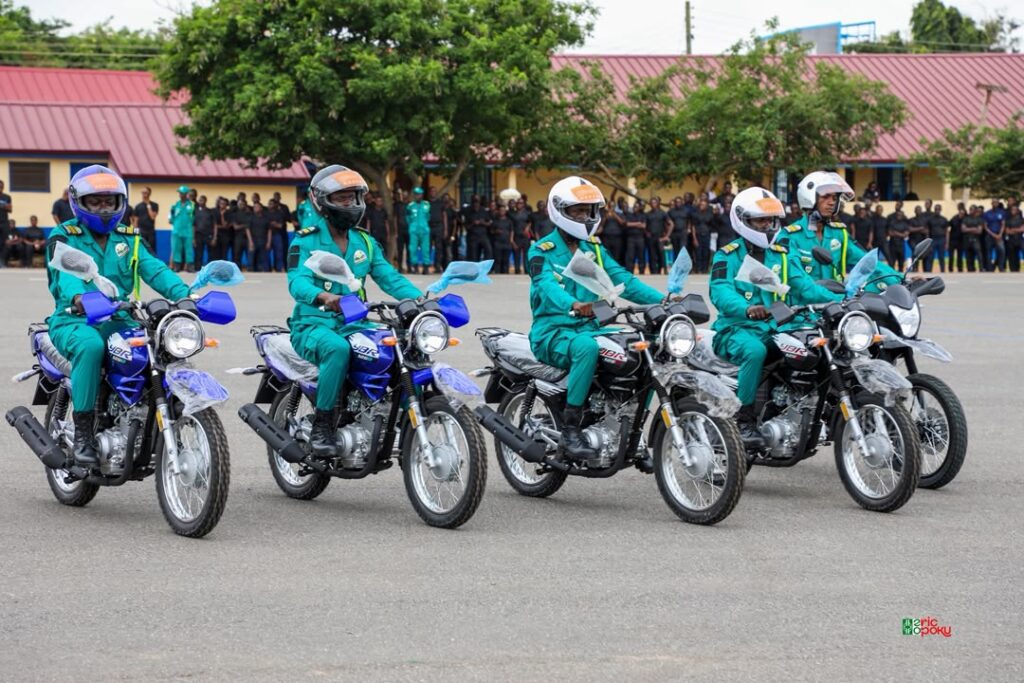
Five hundred and six (506) Feed Ghana Brigadiers, trained agricultural officers with advanced qualifications in agriculture who received stringent training at the Ghana Police Training School with their motorbikes, have been deployed to assist in resetting Ghana’s agriculture for food security.
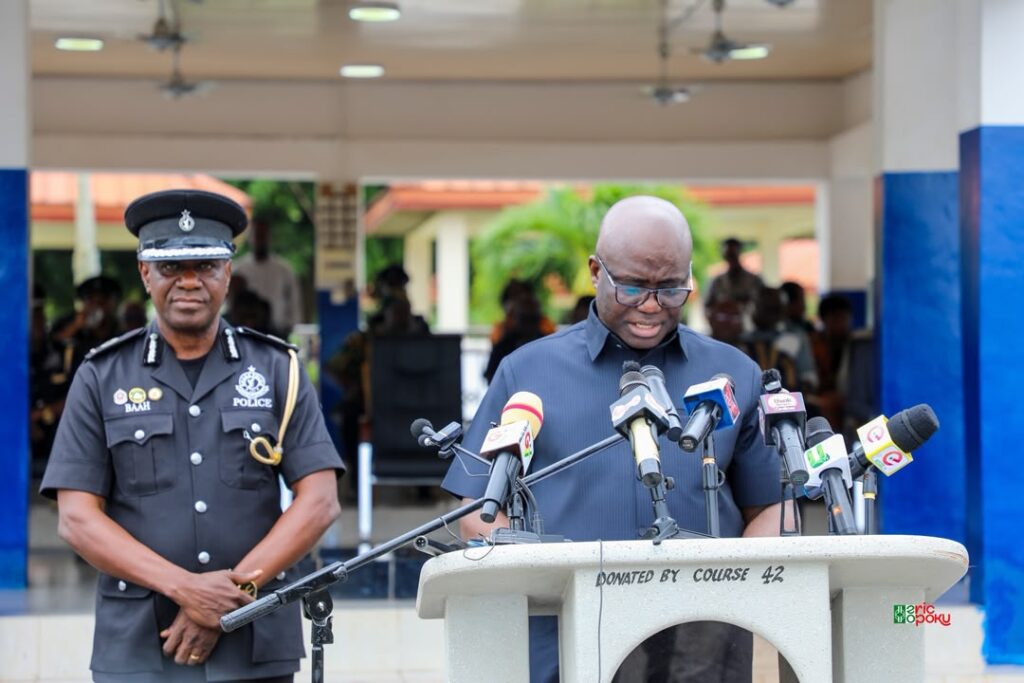
At the passing out ceremony, the Minister of Food and Agriculture, Hon. Eric Opoku, referred to the Brigadiers as the birth of a new national force for agricultural transformation.
According to the Minister, the Feed Ghana Programme requires officers who are punctual, accountable, physically and mentally fit, mission-oriented, and ready to serve in every district of this country.
“Agriculture itself requires discipline. A farmer cannot plant at the wrong time and expect the right harvest. A livestock farmer cannot neglect feeding and health and expect productivity. A coordinator cannot submit false reports and expect successful implementation. A brigadier cannot abandon the field and expect transformation,” he explained.
The Minister for Food and Agriculture, Hon. Eric Opoku, explained the need for an agric officer to be disciplined in the line of duty
He commended the Ghana Police Service for supporting to instil discipline, order, punctuality, and a sense of duty among the Brigadiers to exhibit them in the various districts in the line of duty.
To satisfy the curiosity of some Ghanaians on why the Feed Ghana Brigadiers were trained at the Ghana Police Training School and not in our Agricultural Colleges, the Minister said it was to build discipline, strengthen teamwork, develop resilience, instil respect for authority, and prepare them for field service under pressure.
He underscored the ministry’s commitment to the Brigadiers by conveying the necessary operational and technical orientations, the objectives of the Feed Ghana Programme, the implementation arrangements and the specific roles that they are expected to perform in the districts.
He charged the Brigadiers to be the ambassadors of production, discipline, hard work, and national renewal; however issued a stern caution not to be defiant to the District Agriculture Directors.
The Brigadiers, ready to be deployed to various districts to assist in resetting Ghana’s agriculture for food security.
“The District Director of Agriculture remains the head of the Ministry’s operations at the district level, and I expect every Coordinator to respect that authority and work within the established chain of command. Success will come through cooperation, not competition; coordination, not duplication; and teamwork, not parallel structures,” he cautioned.
He urged the Brigadiers to stay humble, and work as servants under the farmers, strengthen the existing system, but not to replace it, and support the District Directors and the extension officers to be able to deliver the objectives of the Feed Ghana Programme effectively, professionally, and melodiously.
“My dear Brigadiers, you are stepping into your roles at a defining moment. The country, farmers, the government, families, and above all, Ghana, expect much from you. You must therefore serve with humility, discipline, honesty, patriotism, and urgency,” he encouraged them.
The Brigadiers on their motorbikes, displaying their readiness to carry out the task assigned to them by the nation
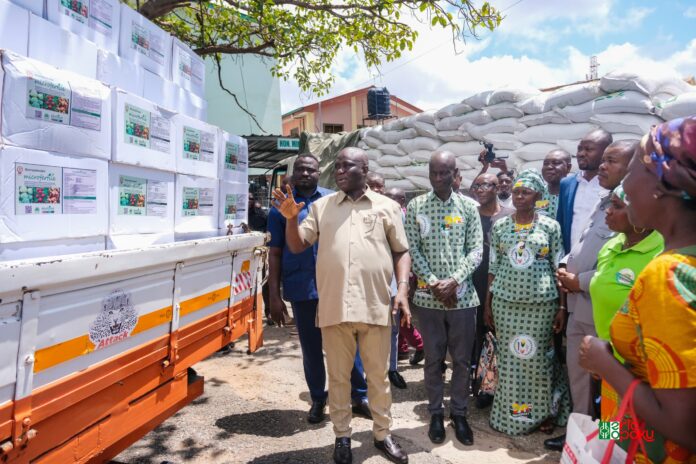
Hon. Eric Opoku, Minister of Agric, presenting the organic fertilizers to the PFAG
The Peasant Farmers Association of Ghana has officially commenced the distribution of the 40,000 bags of fertilizers that were distributed by the Ministry of Food and Agriculture, Hon. Eric Opoku.
The 40,000 fertilisers are to supplement the initial ones that were distributed as part of the Feed Ghana Program’s commitment to supporting farmer groups with essential agricultural inputs.
“We are grateful to the Minister for fulfilling his promise and the timely delivery of this fertilizer. It comes at a critical time in the planting season, and we are confident it will make a meaningful difference in the yields of our members,” the Executive Director of PFAG, Mr. Bismark Owusu Nortey expressed the Association’s gratitude to the Minister.
According to Mr. Nortey, following the delivery of the fertilizers, the Association’s national executives have developed structured modalities to ensure equitable and transparent distribution to its members across all operational districts.
Regarding the distributions, the Association stated that the fertilizers have been allocated to each region based on district-level membership figures, ensuring a proportionate, needs-based allocation.
The Association operates in all sixteen (16) regions of Ghana, with active regional representatives or focal persons in twelve (12) regions. The remaining four regions will be merged with adjacent operational regions to guarantee full geographic coverage.
To qualify for fertilizer under this distribution, beneficiary farmers must be card-bearing members of PFAG and should be in good standing. The Association’s membership exceeds 500,000 farmers, and the national executives have established clear and fair eligibility criteria to guide the selection process at the district level.
Mr. Nortey mentioned that PFAG is using the approach to call for the continued adoption of the farmer group distribution model. He described it as the most effective and accountable approach to input delivery.
He urged the government to extend this model of distribution to other agricultural inputs and services and called for direct support to enable farmer groups to aggregate and supply food produce to state institutions.
He further called on the government to put in place adequate market support measures, noting that with timely fertilizer supply and favourable weather conditions, PFAG expects improved yields this season and anticipates that farmers will have ready access to viable markets for their produce.
Currently, Ghana’s import bill is around $3billion annually. To mitigate importation, create more employment, and improve the living standard of the farmers, the government, through the hardworking agric Minister with the auspices of Feed Ghana Project, is constructing the biggest irrigation project in West Africa at Afram Plains to ensure year-round production of food crops.
The hardworking Minister of Food and Agriculture, Hon. Eric Opoku, has paid a working visit to inspect the ongoing irrigation projects at Afram Plains to assess the 96% and 85% completion of the projects to ensure national food security.
A Visit to Kwahu Chiefs During the visit, the Minister paid homage to both the Kwahu Nkwatia and Kwahu Abetifi chiefs to seek permission to enter the land and their prayers and support to make the journey and the project a success.
The Chiefs warmly welcomed the Minister and gladly said the lands are available for production, but without sowing, there cannot be a harvest.
“We have the lands available, where the irrigation project has been built, all for us. We are happy this project is taking effect; it will bring employment to the youth at the Afram Plains”, the Chiefs added.
They commended the government and the agric minister for the project that seeks to irrigate the farms all year-round to ensure food security in the country.
They assure the minister of their support and commitment to the project for the benefit of Ghanaian youth.
Ekyeamamfrom Economic Enclave Irrigation Project The Minister continued his visit to Ekyeamamfrom Economic Enclave Irrigation Project. The project was 85% complete for use.
According to the consultant, the project could irrigate eight hundred (850) and fifty acres of land that could serve thousands of farmers at the enclave. Hon. Minister was fascinated by the amount of water that the scheme could provide to the farmers.
Irrespective of the size of the project, the Minister is willing to add more land for more pivots and pumps to be constructed.
Questioning the total completion of the scheme to be used by the farmers, the consultant assured that the earliest the project can be completed is August, and the worst time is early September this year.
Challenges at the Ekyeamamfrom Economic Enclave Irrigation Project The consultant raised two critical issues regarding the completion of the project. He mentioned that certificates for payment have been raised, but the government has been able to pay only 40%; therefore, they are short of funds.
Again, the issue of Fulani herdsmen is very disturbing to the project. According to the consultant, the government needs to evacuate the Fulani with their cattle from the enclave. He explained that the Abetifi Traditional Council has had discussions with the Fulani herdsmen and has located them a place for resettlement; therefore, it’s left to the government to evacuate the herdsmen to the location.
Response by the Minister In response to these challenges, the Minister assured him that he would follow up with the Ministry of Finance to ensure prompt payment to complete the project on time for the farmers to ensure production all year round.
He called the District Chief Executive to arrange for the evacuation of the Fulani from the project location to the place allocated.
Konadu Economic Enclave Irrigation Project Proceeding to the Konadu Irrigation Project, the project is 96% completed according to the consultant. He said the project would be completed and handed over to be used in November this year. The Konadu Irrigation Project is the biggest irrigation facility in West Africa.
Challenges at the Irrigation Site The consultant said the completion time is near, but the officers to be trained to use the facility are not at their disposal.
He mentioned that there particular building that is blocking seven pivots from irrigating the farms and that needs to be demolished. Again, he underscored the challenges that the project is facing at the hands of the Fulani herdsmen.
Lastly, illegal timber loggers are causing destruction to the roads that have been constructed in the irrigation site. The timber loggers plough the road to illegally transport the timber logs to their destination.
Minister’s Response to the Challenges Minister called the DCE to immediately assist in demolishing the building that has blocked the pivots from irrigating 360 degrees.
Moreover, he urged the DCE to facilitate the evacuation of the Fulani herdsmen from the project site to the allocated land.
To the illegal loggers, the Minister said the DCE should coordinate with the police to arrest the drivers who use the farm roads as their route. He urged the DEC to construct a checkpoint at the entrance and the exit of the farm road to monitor the accessibility of the various vehicles that use the road.
Minister’s observations and remarks on the visit to the Irrigation project. “Generally, we are impressed with what we have seen so far, except that the work is not completed. We all hope that by November, the entire facility will be ready,” the minister commended.
He urged them to make arrangements with the officers for the consultant to train in order to facilitate the use of the facility.
He noted that the government and the ministry are not interested in the materials in the field, but rather the services that can be rendered to the people of Ghana after committing their resources to the government.
He urged them to work assiduously to complete the operationalization for the Ghanaian farmers and to safeguard food security in the country.
He commended the Abetifi Traditional Council for its commitment to the project. He urged the council to assist with the security issues in the enclave, especially with the Fulani herdsmen, the encroaching buildings, and the timber logging.
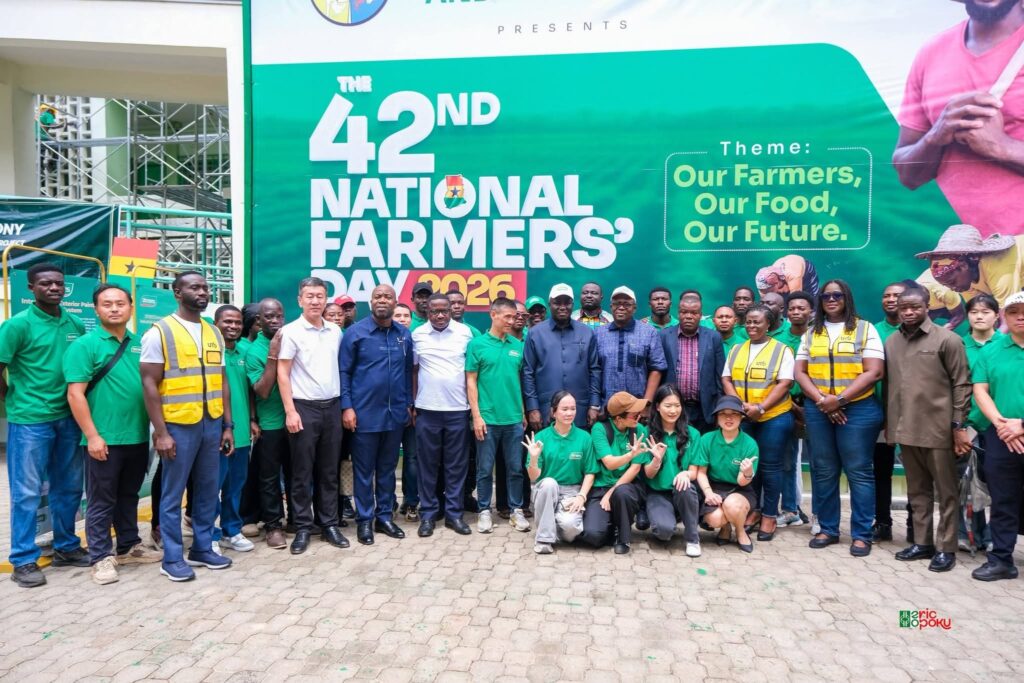
The 42nd Farmers Day Celebration has been launched at the forecourt of the Ministry of Food and Agriculture with 4th December as the celebration day in Sunyani, the Bono Region.
This year’s Farmers Day, with the theme Our Farmers, Our Food, Our Future, seeks to recognise the hardworking farmers, fishers, processors, extension officers, researchers, agribusinesses and all actors who sacrifice to sustain Ghana’s food systems and strengthen the economy.
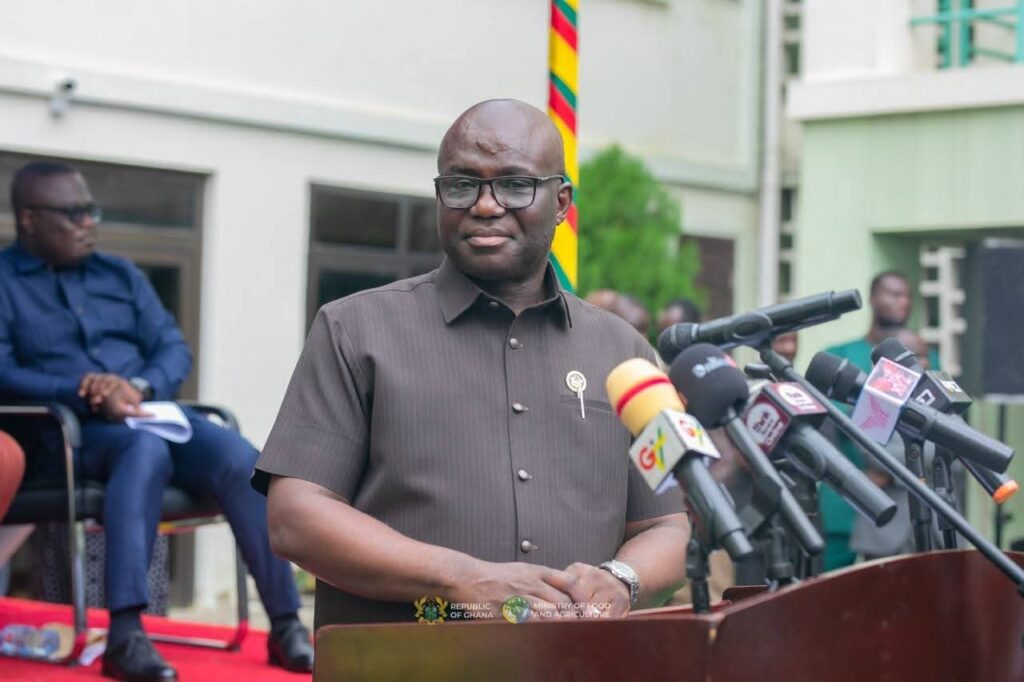
Speaking at the launch, the Minister of Food and Agriculture, Hon. Eric Opoku, espoused why the celebration is not just a celebration of agriculture but a celebration of national life.
Minister of Food and Agriculture, Hon. Eric Opoku, explaining the significance of the Farmers’ Day Celebration during the launch
“Every grain of rice, every tuber of yam, every basket of tomato, every crate of eggs, every kilogramme of fish, every litre of milk and every cocoa pod is a product of labour, patience, risk and hope. Behind the food on our tables is a farmer who woke up before sunrise. Behind our markets is a fisher who faced the sea. Behind our agro-industries is a producer who believed that Ghana could feed itself and feed others”, he extolled.
Undeniably, agriculture remains the foundation of Ghana’s development that gives meaning to the national aspiration for inclusive growth.
No country has achieved true transformation by neglecting agriculture, and no nation can secure its future while depending helplessly on others for the food it can produce. With this, the government is poised to make agriculture attractive and reliable for youth and the industry and dependable for the nation.
Some of the stakeholders at the launch
Deducing the meaning of the theme, the Minister explained that the meaning of the theme signifies that Ghana’s development will not be imported, food security will not be outsourced, and the future will be built by the strength of its own people, beginning with the farmer.
As is already known, the Farmers’ Day Celebration will be preceded by a weeklong agrifair with a series of activities that will build farmers’ capacity in all sectors of the agriculture industry. The last day would be climaxed by the awards to reward farmers who have diligently worked for the betterment of the nation.
He called on the various institutions, corporate organizations, agro-industries, development partners, and the general public to contribute to the organization to reward our special people who make life possible by providing food for Ghanaians every blessed day.
Farmers’ Day is a day set aside by the Government of Ghana through the Ministry of Food and Agriculture to reward the intrepid farmers who have toiled to provide food for Ghanaians.
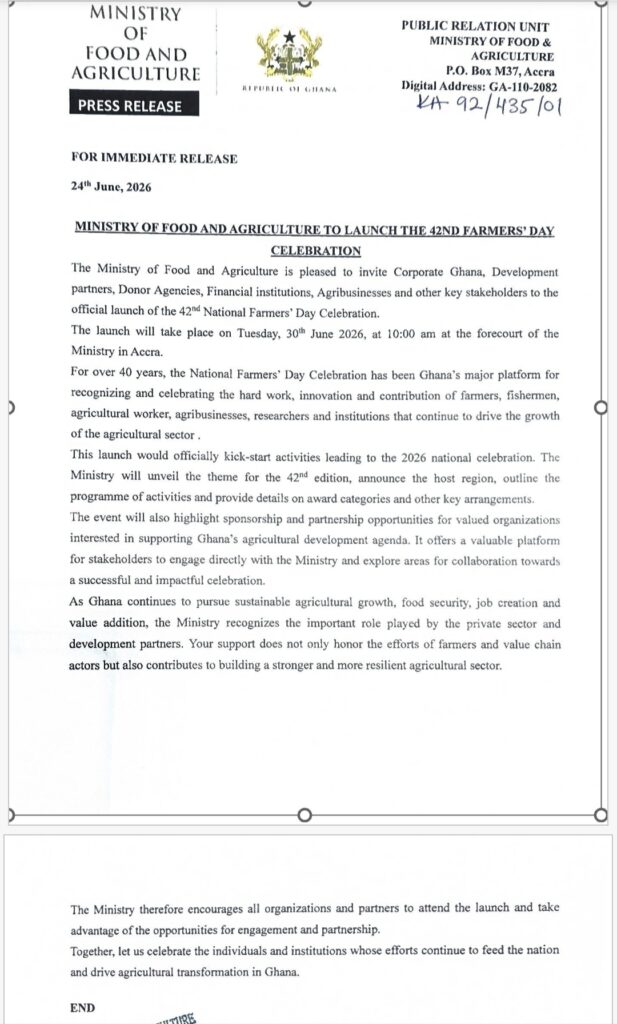
This year marks the 42nd of the Farmers’ Day Celebration. To ensure absolute inclusion the Ministry of Food and Agriculture is inviting Corporate Ghana, Development partners, Donor Agencies, Financial Institutions, Agribusinesses and other key stakeholders to the official launch.
The launch will be held at the forecourt of the Ministry of Food and Agriculture on Tuesday 30th June, 2026 at 10:00am.
In a press release issued by the Ministry, the Ministry will unveil the theme for the 42nd edition, announce the host region, outline the programme of activities and provide details on award categories and other key arrangements.
According to the release, the launch will highlight sponsorship and partnership opportunities for interested organisations or stakeholders who are willing to support.
As Ghana continues to pursue sustainable agricultural growth, food security, job creation and value addition, the press release reads the Ministry recognizes the important role played by the private sector and development partners.
“Your support does not only honor the efforts of farmers and value chain actors but also contributes to building a stronger and more resilient agricultural sector”, the release states.
The Ministry urges all organisations and partners to partake in the launch and take advantage of the opportunities for engagement and partnership.
The Ministry calls all to celebrate both the individuals and institutions whose efforts continue to feed the nation and drive agricultural transformation in Ghana.